How Left Luggage Works In New York City: A Visitor's Guide
If you searched for left luggage in New York, you used a word the city itself does not use, and you are looking for a service that mostly does not sit in the stations. Here is what actually exists, verified against each operator's own published pages.
Short answer
New York has no public left-luggage lockers in its stations. The one staffed left-luggage counter inside a Manhattan transport hub is Amtrak's bag storage at Penn Station and Moynihan Train Hall: $20 per item per 24 hours with a train ticket, $30 for the general public with photo ID. Elsewhere, staffed storage points near stations typically charge $4.90 per bag per day plus a $1.99 checkout fee.
The phrase "left luggage" is what a traveller from Britain, Ireland or Australia types into a search box. It is the standard term at railway stations across London, Dublin and Sydney: you hand a bag over a counter, pay by the day, collect it later. New York does not use the phrase at all. Ask a New Yorker where the left luggage office is and you will get a blank look, because the city's transport hubs mostly have no such office, no counter and no locker bank either. That gap between the word you know and the city you are standing in is where most confusion starts, and this guide closes it with what each operator actually publishes, in its own words, on its own pages.
What Does "Left Luggage" Mean In New York?
In New York, "left luggage" has no official meaning: no station, airport information desk or venue sign uses the phrase, and the service it describes exists in only a few staffed forms. Amtrak runs a bag-storage counter at Penn Station and Moynihan Train Hall, Smarte Carte runs counters at two JFK terminals, and a network of staffed shop counters around the city fills the remaining gap. Nothing in a New York transport hub is a self-service locker.
The honest starting point is the locker question, because the two ideas get tangled. A locker is a machine: you put the bag in yourself, you keep the key or code, nobody else touches your case. A left-luggage counter is the opposite: a person takes the bag, tags it, shelves it and hands it back when you return. New York's transport hubs have almost none of the first and, until recently, very little of the second. The one genuine left-luggage service inside a Manhattan rail hub is Amtrak's, and it is a staffed counter, not a locker bank.
The site's own measured inventory backs this up from the other side. Across the eight storage areas this publisher lists, there are 88 distinct staffed storage points, and zero of them is a locker. Every single one is a counter inside a shop, cafe, hotel or delivery service where a person receives your bag. So the European mental model, "find the locker room at the station", simply has no New York equivalent, and pretending otherwise is how travellers end up dragging a suitcase through a subway they did not plan to use. This is the honest picture that Luggage Storage Lockers in New York City was built to explain, hub by hub, against each operator's own published pages.
Where Left Luggage Actually Exists In New York
Left luggage exists at exactly three kinds of place: Amtrak's staffed counter at Penn Station and Moynihan Train Hall, Smarte Carte's staffed counters at JFK Terminal 1 and Terminal 4, and the citywide network of staffed storage points around stations and landmarks. Grand Central and the Port Authority Bus Terminal publish no storage at all, and no hub has lockers.
Start with the strongest fact, because it is the single most contradicted piece of travel content about this city. Penn Station does have left luggage, and a person with no train ticket at all can use it. Amtrak publishes the terms plainly on its baggage services page: "Temporary bag storage is available to both Amtrak customers (valid ticket required) and the general public (valid photo ID required)." The rates are $20 per item per 24-hour period for Amtrak customers, and $30 per item for the general public. For items stored longer than 24 hours, the rate is charged again at the beginning of each additional 24-hour period. Most travel content says New York's stations have nothing. Amtrak's own page says otherwise.
The second place is the airport. Smarte Carte operates bag storage at JFK Terminal 1 and Terminal 4, staffed counters with published hours: Terminal 1 is open 7:00 AM to 10:00 PM every day, and Terminal 4 is open 24 hours. The operator's own page lists the conditions, including "Photo ID and Boarding Pass Required" and "All Bags Must Be Locked", which means you need to bring your own lock. The price is the one thing nobody can tell you in advance: no Smarte Carte page, no JFK page and no Port Authority page publishes a rate, and the booking flow will not yield one either. The operator publishes a phone number for the service, 718-916-8963, so the honest answer to "what does JFK storage cost" is: call, because the operator will not publish it.
Then there is what does not exist, which is just as load-bearing. Grand Central Terminal's own FAQ answers the question flatly: "Does Grand Central offer luggage storage? No, there are no luggage storage services at Grand Central. Please plan ahead if you are arriving with luggage." The Port Authority of New York and New Jersey says the same thing about its bus terminal, twice, on its own pages: "The Port Authority of New York and New Jersey does not provide baggage storage facilities at the bus terminal." The full hub picture, each line from the operator's own site:
| Hub | Left-luggage service? | Lockers? | What the operator publishes |
|---|---|---|---|
| Penn Station / Moynihan Train Hall | Yes, Amtrak staffed counter | No | $20 per item per 24h with a ticket, $30 for the public with photo ID |
| Grand Central Terminal | No | No | "There are no luggage storage services at Grand Central" |
| Port Authority Bus Terminal | No | No | "Does not provide baggage storage facilities at the bus terminal" |
| JFK Terminal 1 | Yes, Smarte Carte counter | No | Open 7:00 AM to 10:00 PM daily, price not published |
| JFK Terminal 4 | Yes, Smarte Carte counter | No | Open 24 hours, price not published |
| LaGuardia | None listed | No | Airport lists carts, baggage office and oversized baggage only |
| Newark Liberty | None listed | No | Airport lists carts, baggage office and oversized baggage only |
The gap between the hubs that say no and the travellers who arrive with bags anyway is filled by the staffed-point network. Around Penn Station alone there are 27 storage points within 800 metres, rated 4.84 across 3,583 reviews. Around the Port Authority Bus Terminal there are 36, rated 4.79 across 2,126 reviews. Around Grand Central, whose own terminal refuses bags, there are 14 points just outside the door, rated 4.7 across 502 reviews. These are shops and counters, not facilities run by the stations, and that distinction shapes everything about how you book and what you should expect. For the full picture of the one counter that sits inside the station itself, see the companion guide to Amtrak baggage and bag storage at Penn Station.
What Left Luggage Costs In New York
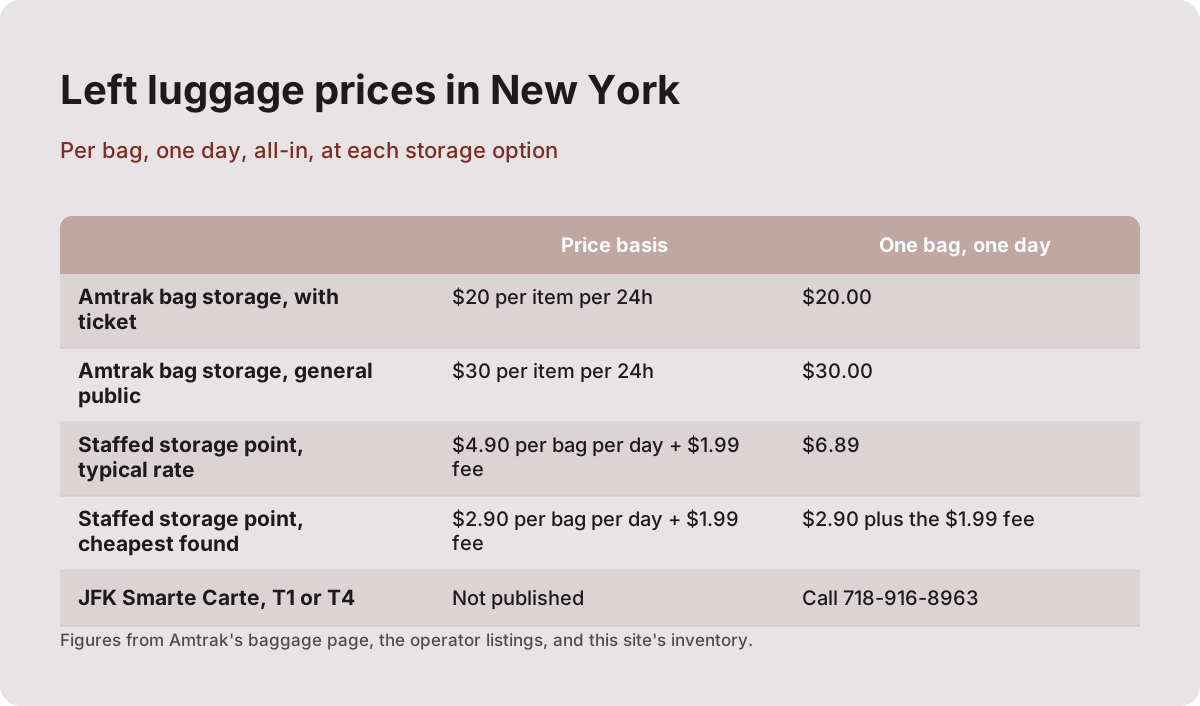
Left luggage in New York costs either $20 or $30 per item per 24 hours at Amtrak's Penn Station counter, depending on whether you hold a train ticket, or typically $4.90 per bag per day plus a $1.99 per-bag checkout fee at the staffed points around the city, which works out to $6.89 all-in for one bag for one day. JFK storage has no published price at all.
The two price structures are completely different animals, and knowing which one you are walking into is the whole decision. Amtrak prices per item, per 24-hour period, at a counter inside the station: $20 with a valid ticket, $30 with photo ID and no ticket. The staffed-point network prices per bag, per day, at a counter in a nearby business: the typical New York rate is $4.90 per bag per day, and a $1.99 fee per bag is added at checkout. The all-in arithmetic is straightforward. One bag for one day is $6.89. One bag for three days is $16.69, because the checkout fee is charged once per bag, not per night. For a single suitcase on a single day, the staffed-point route is less than a quarter of the general-public Amtrak rate, and that gap is the reason the network exists at the scale it does.
The advertised floor price deserves one honest paragraph, because you will see it. Radical Storage, the network behind these points, advertises New York storage "from $2.90" on its own page, and that same page also advertises "from $4.90/day" in its hero. The company now disclaims the lower figure in its own words: "Prices start from $2.90 per bag. This is the lowest currently available city price, not a promise that every location or bag category has the same rate." This site's own measurement found 168 of 178 real New York point cards showing $4.90. So $4.90 is the rate to plan around, and $2.90 is the rate to be pleasantly surprised by, never the reverse. The full cost picture, including what the fee does to multi-day stays, is laid out in the companion guide to what luggage storage costs in New York city.
| Option | Where | Price basis | One bag, one day, all-in |
|---|---|---|---|
| Amtrak bag storage, with ticket | Penn Station / Moynihan counter | $20 per item per 24h | $20.00 |
| Amtrak bag storage, general public | Penn Station / Moynihan counter | $30 per item per 24h | $30.00 |
| Staffed storage point, typical rate | Around stations and landmarks | $4.90 per bag per day + $1.99 fee | $6.89 |
| Staffed storage point, cheapest found | Near Central Park at two subway-adjacent points | $2.90 per bag per day + $1.99 fee | $2.90 plus the $1.99 fee |
| JFK Smarte Carte, T1 or T4 | Inside the airport | Not published | Call 718-916-8963 |
The cheaper $2.90 rate at Central Park deserves its own sentence because it is genuinely rare: within this site's eight areas it exists at exactly two points, at 72 St Subway Station and Cathedral Pkwy / 110 St, and nowhere else. If your day centres on the park, those two points are the cheapest bag storage in the inventory. Everywhere else in the network, $4.90 is the honest planning number. If a Penn Station drop fits your route better, you can Check availability among the 27 points within 800 metres of the station.
How A Staffed Left-Luggage Point Works
A staffed point works like a hotel bell desk: you book or walk in, a person tags your bag and gives you a receipt, the bag goes on a shelf behind the counter, and you collect it by showing the receipt before the point closes. There is no code, no key and no machine, and the hours that matter are the shop's hours, not the station's.
The mechanics are simple but they carry expectations a locker user would not have. You are handing your bag to a person in a business, usually a shop, cafe or hotel lobby, that has signed up to a storage network. The booking names an area rather than an exact street address until after payment, which is a real and documented friction point: one recent guest review on the operator's Trustpilot page complains that the company "refuses to share even an approximate storage address until AFTER you've paid". Set that expectation before you book and it stops being a problem: you choose a zone, you pay, you get the specific point. Walk-ins are also possible at most points, though a booked bag is a guaranteed slot and a walked-in bag is not.
What you get at the counter is a receipt and a tagged bag, and that receipt is the whole contract at collection. Show it, get the bag. Lose it, and you are at the mercy of the point's own ID-checking practice, which is not standardised across the network. The hours matter more than most first-time users expect: 25 of the 27 points around Penn Station publish their hours, and a point that closes at 7 PM will not reopen at 9 PM because your train does. The companion guide on how a New York bag drop-off works walks through the whole sequence with the receipt, the tagging and the collection window in detail.

The staffed model also explains what the guarantee actually is. The network's terms cover each stored bag for a value of EUR 3,000 per claim, and the terms are explicit that this is not insurance. Two deadlines bind a claim: a one-week window to file, and a 48-hour window to produce a police report. The marketing pages advertise a larger figure, shown as both dollars and euros on the same page, but that figure appears nowhere in the terms, so the EUR 3,000 clause is the only number worth planning around. Around Grand Central, where the terminal itself refuses bags, the staffed points just outside carry the same terms, and the 14 points within 800 metres of that end of Midtown are worth comparing if Grand Central is where your day begins or ends.
What You Can And Cannot Leave In Left Luggage
You cannot leave electronics in a stored bag at the staffed points: the network's own terms prohibit "Technological material (iPhone, iPad, Tablet, PC, smartphones)", and a prohibited item voids the entire guarantee claim. Amtrak's counter prices per item with no published size limit, and JFK requires every stored bag to be locked and carried with a boarding pass.
The electronics ban is the single most important clause in the whole system and almost nobody reads it before dropping a bag. The terms list technological material among the prohibited items, verbatim, and clause 9.8.12 makes the consequence total: a prohibited item voids the entire claim, not just the claim for the laptop. So the bag containing a phone is a bag with no coverage at all, whatever the marketing pages say about protection. Take the laptop and the phone out before you hand over the case. This is not a fine-print quirk, it is the difference between a covered bag and an uncovered one, and it applies at every point in the network equally.

The other operators publish their own lists, and they differ in ways worth checking before you arrive. Smarte Carte at JFK prohibits flammable materials, alcohol, firearms and perishables, and requires all bags to be locked. Amtrak's temporary storage page prices "per item" and publishes no dimension, no weight and no bag-count limit, which means the honest answer to "how big can my stored bag be at Penn" is that nobody has published one. The venue rules are a different question again, and they are the reason most people need storage in the first place: Yankee Stadium permits only one soft-sided bag of 16 by 16 by 8 inches and states "there is no storage area for any items at Yankee Stadium", and the 9/11 Memorial caps bags at 19 by 17 by 8 inches before mandatory storage in its own coat rooms. A quick summary of what each operator accepts:
| Operator or venue | Published restriction | Consequence of breaking it |
|---|---|---|
| Staffed-point network | Electronics prohibited in stored bags | Voids the entire guarantee claim |
| Staffed-point network | Guarantee is EUR 3,000 per bag, per claim, not insurance | One-week claim window, 48-hour police-report window |
| Amtrak, Penn Station | No published size, weight or count limit | Unknown, ask at the Customer Service desk |
| Smarte Carte, JFK | Bags must be locked, ID and boarding pass required, no flammables or perishables | Refusal at the counter |
| Yankee Stadium | One soft bag, 16 x 16 x 8 in, hard-sided banned | No storage area exists for refused items |
| 9/11 Memorial | Bags over 19 x 17 x 8 in not permitted onto the Memorial | Mandatory storage in the museum's own Coat Rooms |
The practical read of that table is simple. If your bag contains anything with a battery and a screen, take those items out and carry them. If your bag is oversized for a venue, the venue will not hold it, and neither will the station, so the staffed-point network is the only general-purpose option. The full list of what belongs nowhere near a stored bag, from batteries to valuables, is covered in the dedicated guide to what you cannot leave in a stored bag in New York.
Overnight And Multi-Day Left Luggage
Multi-day left luggage works at both systems: Amtrak recharges its $20 or $30 rate at the start of each additional 24-hour period, and the staffed points charge $4.90 per bag per day with the $1.99 checkout fee charged once, so three days costs $16.69 for one bag. Nothing in either system is designed for weeks-long storage.
The fee structure is where multi-day arithmetic diverges hard between the two options. At Amtrak's counter, the per-item rate resets in full every 24 hours, so a ticketed traveller pays the $20 rate again each day and a ticketless traveller pays the $30 rate again each day. At a staffed point, three days is $16.69 for one bag, because the $1.99 fee is once per bag, not per night. The longer you store, the wider the gap gets, and at no realistic duration does the Amtrak counter come out cheaper for a ticketless traveller. The counter's advantages are location and simplicity: it is inside the station, it takes any item it can shelve, and there is no address-reveal dance at booking.
Overnight storage raises a different question: who is open when you want the bag back. The staffed points publish their hours, and a point that shuts overnight will not hand your bag back at midnight. Amtrak's counter sits inside Moynihan Train Hall, which publishes its own public hours as 5:00 AM to 1:00 AM daily, with Amtrak and LIRR service moving across the avenue to Penn Station between 1:00 AM and 5:00 AM. So a bag stored with Amtrak cannot be retrieved from the Train Hall in that overnight gap, because the hall itself is shut. The deeper mechanics of overnight and multi-day stays, including what happens when your retrieval slips a day, are laid out in the guide to overnight and multi-day bag storage in NYC.
Getting Your Bag Back: The Hours That Actually Matter
The hours that matter are the storage point's own published hours, not the station's, and the two are rarely the same: Moynihan Train Hall opens to the public 5:00 AM to 1:00 AM, Amtrak's checked-baggage window at Penn runs 5:00 AM to 10:00 PM, and the staffed points each publish their own closing times, which you should read before booking.
This is the mistake that ruins an otherwise well-planned day. A traveller stores a bag near a station, assumes the station's hours apply, and returns at 11 PM to a shuttered shop. The station is open, the platform is open, the bag is behind a locked counter. The network's own data makes this avoidable: across the eight areas this site lists, nearly every point publishes its hours, 25 of 27 around Penn Station, 34 of 36 around Port Authority, 42 of 44 around Times Square. Read the hours on the point's card before you book, and match them to your return time, not your drop-off time.

The Amtrak side has its own version of the same trap. Moynihan Train Hall publishes its public hours on its getting-here page: "Moynihan Train Hall is open to the public daily from 5:00AM to 1:00AM. Note: overnight (1:00AM to 5:00AM) Amtrak and LIRR services only available at Penn Station across 8th Avenue." Amtrak's own station record for New York Penn lists its checked-baggage service at 5:00 AM to 10:00 PM, with passenger assistance available 24 hours. The counter's separate hours, as distinct from the checked-baggage window, are not published anywhere, so the honest planning rule is to treat 10 PM as the latest safe retrieval and to ask at the Customer Service desk when you drop off. If your day runs later than that, the staffed points around the station, several of which stay open into the evening, are the more forgiving choice, and the 44 points around Times Square are worth comparing if your evening ends in the theatre district.
One more timing note for anyone flying. The airport publishes a standing advisory that "Getting to and from JFK may take longer than usual due to construction at the airport. Please allow for significantly more time." That sentence belongs in your retrieval planning, not just your departure planning: a bag you cannot collect in time is a bag that misses the flight with you. Build the collection into your schedule with the same margin you would give the outbound leg.
Choosing Your Left-Luggage Spot In New York
Choose by retrieval, not by drop-off: pick the point whose closing time comfortably covers your return, whose area matches where your day actually ends, and whose all-in price you have checked including the $1.99 fee. Around stations, Penn Station offers the deepest inventory at 27 points rated 4.84 across 3,583 reviews, and Times Square the widest at 44.
The single best piece of planning advice this record supports is to work backwards from the moment you need the bag. Drop-off is easy: you are awake, the bag is with you, any point on the route works. Retrieval is the moment with a deadline, a closing time and a train to catch. So pick the area where your day ends, filter by points whose published hours outlast your return, and only then compare price. The $2.90 points near Central Park are the cheapest in the city, but they are worthless to a traveller whose evening ends at Penn Station at 10 PM with a bag on the other side of the park.
The inventory picture across the eight areas, all counts measured within 800 metres of each area's anchor:
| Area | Points within 800 m | Rating | Reviews | Typical rate |
|---|---|---|---|---|
| Times Square | 44 | 4.79 | 2,400 | $4.90 per bag per day |
| Port Authority | 36 | 4.79 | 2,126 | $4.90 per bag per day |
| Central Park | 33 | 4.79 | 762 | $4.90, with two points at $2.90 |
| Penn Station | 27 | 4.84 | 3,583 | $4.90 per bag per day |
| Midtown Manhattan | 16 | 4.7 | 596 | $4.90 per bag per day |
| Grand Central | 14 | 4.7 | 502 | $4.90 per bag per day |
| Brooklyn | 11 | 4.82 | 79 | $4.90 per bag per day |
| World Trade Center | 4 | 4.72 | 201 | $4.90 per bag per day |
Two honest notes on those numbers. First, the World Trade Center area is thin: four points, because the area is small and the immediate inventory is genuinely limited, so book ahead there rather than walking in. Second, review counts are not comparable across areas the way they look: a 4.82 from 79 reviews in Brooklyn is a small pool, not the same evidence as 4.84 from 3,583 around Penn Station. Both are real ratings from real bookings, but the Penn figure carries far more weight. Whatever you choose, the booking itself is cancellable, so reserving a point near your end-of-day location costs you nothing if your plans shift.
Common Questions About Left Luggage In New York
Does New York have left luggage?
Yes, but not where a European traveller would look for it. Amtrak runs a staffed bag-storage counter at Penn Station and Moynihan Train Hall, open to the general public with photo ID at $30 per item per 24 hours, and Smarte Carte runs counters at JFK Terminal 1 and Terminal 4. Grand Central and the Port Authority Bus Terminal publish no storage at all, and no New York transport hub has lockers.
Is left luggage the same thing as a luggage locker?
No. Left luggage means handing a bag over a staffed counter and collecting it later with a receipt. A locker is self-service: you keep the key or code. New York's transport hubs have no public luggage lockers, and every storage point in the citywide staffed network is a counter in a shop, cafe or hotel, staffed by a person who tags and shelves your bag.
How much does left luggage cost in New York?
At Amtrak's Penn Station counter, $20 per item per 24 hours with a valid train ticket, $30 without one. At the staffed points around the city, the typical rate is $4.90 per bag per day plus a $1.99 per-bag checkout fee, which is $6.89 all-in for one bag for one day. JFK storage has no published price: the operator publishes hours and rules but no rate, so call ahead.
Can I leave a bag overnight in New York?
Yes. The staffed points charge per day, so an overnight stay is simply two days of the daily rate, with the $1.99 checkout fee charged once per bag. Amtrak's counter recharges its rate at the start of each additional 24-hour period. The constraint is hours, not permission: check the point's own closing time and opening time against when you want the bag back.
Can I leave electronics in a stored bag?
No, not in the staffed-point network. The operator's own terms prohibit storing technological material including phones, tablets and laptops, and a prohibited item voids the entire guarantee claim, not just the claim on that item. Take electronics out and carry them with you before handing over the bag.
Do I need a booking, or can I walk in?
You can walk in at most staffed points, but a booked bag is a guaranteed slot and a walked-in bag is not. One documented friction of booking is that the specific address is revealed only after payment, so you are choosing an area rather than a street. Book the area that matches where your day ends, and read the point's published hours before confirming.