Can I Wait Overnight At JFK Airport
An honest look at waiting out the night at JFK: what the airport publishes about overnight bag storage, the 24-hour Terminal 4 counter, and the alternatives in Manhattan.

Can I Wait Overnight At JFK Airport
Yes, you can wait overnight at JFK, and people do, but the airport itself publishes almost nothing designed for it. There are no published sleeping facilities, no published rest zones and no published terminal-closure schedule, and the only service at the airport that runs around the clock is the Smarte Carte bag storage counter in Terminal 4, which needs a confirmed ticket and photo ID. The honest answer is that an overnight wait is possible, uncomfortable, and much easier if the bag is not on your lap.
The question usually arrives with a specific shape: a 6 AM departure, a late arrival the night before, and a hotel night that costs more than the flight. The traveller asking it is not looking for luxury. They want to know whether the airport will let them stay, whether anything is open, and above all what to do with the suitcase, because a suitcase is what turns a hard bench into an impossible one.
The airport's own published material answers almost none of this directly. What it does publish is a services list, a set of terminal pages and an AirTrain page, and those three things between them sketch the real picture. The services list for JFK includes baggage storage, which is more than LaGuardia or Newark can say, both of which list only carts, baggage offices and oversized baggage. That single entry is the reason an overnight wait at JFK is more survivable than the same wait at the city's other airports. For the wider picture of leaving a bag at an airport terminal rather than a train station, the site's guide to how left luggage works in New York covers the whole landscape.
This article walks through what is actually published: where the storage counters are and when they are open, what the rules are, what the night costs in practice, and the alternative that most overnight waiters never consider, which is putting the bag into storage in Manhattan and sleeping anywhere else. The first step is the terminal you will be sitting in.
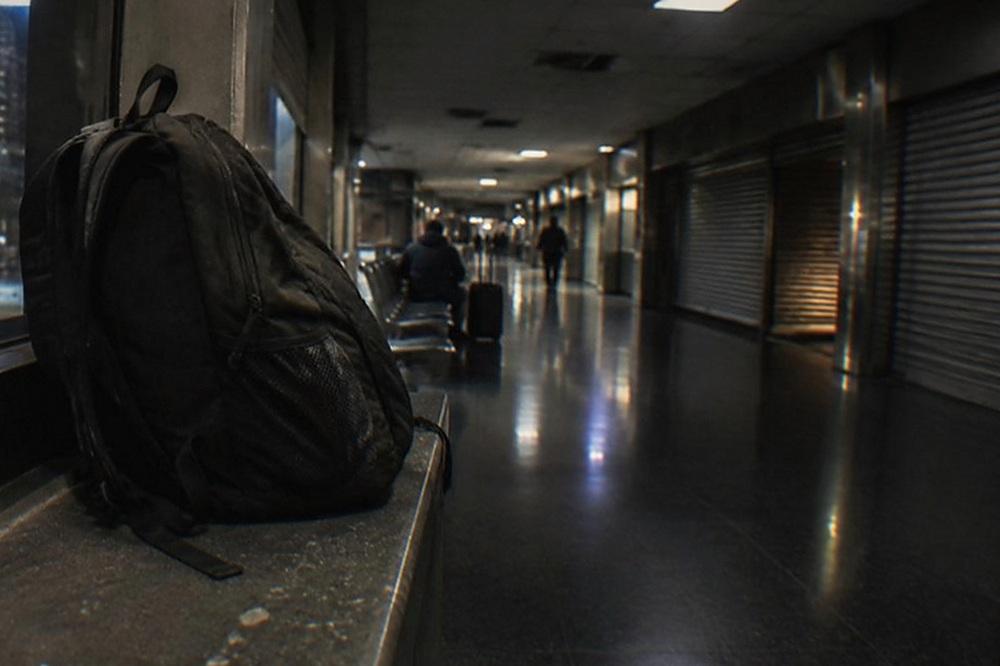
Where Can You Actually Sit Through The Night At JFK?
The airport publishes no overnight seating plan, no rest-zone policy and no terminal closure schedule, so nobody can tell you in advance which seats will be open at 3 AM. What is published is that Terminal 4's bag storage counter runs 24 hours a day, Terminal 1's runs 7:00 AM to 10:00 PM, and the AirTrain fare to leave and return is $8.75 each way. Everything else about the night itself is unwritten.
That absence is worth dwelling on, because most content on this subject is invented confidence. Pages will tell you which terminal has the "best sleeping spots" and which benches are armrest-free, and none of it comes from the airport. JFK's own terminal pages describe airlines, shops and services; they do not describe where a person may lie down, or whether they may. The honest position is that the airport tolerates overnight passengers without publishing a policy for them, and that your experience will depend on the terminal, the night and the staff on shift.
What you can plan around is concrete. If your bag is the problem, Terminal 4 is the terminal that solves it, because its storage counter never closes. The operator's own page states it plainly: Terminal 4 is "Open Everyday / 24 hours per day", while Terminal 1 is "Open Everyday / 7:00 AM - 10:00 PM EST". A traveller with a midnight arrival and a dawn departure can hand the bag over at any hour in T4. In Terminal 1 the same traveller has a window, and outside it the bag stays with them.
The other published constraint is money and time. The airport's AirTrain page gives the one-way fare between JFK and Jamaica or Howard Beach as $8.75, and it carries a standing advisory that "Getting to and from JFK may take longer than usual due to construction at the airport. Please allow for significantly more time." For someone weighing a quick trip into the city mid-wait, that advisory is the airport's own warning that the margin may not exist. The same page notes the system is built for "travelers with mobility devices, strollers, or luggage", with elevators and escalators at the stations, so the train itself expects your suitcase.
What Happens To Your Bag While You Wait
Terminal 4's Smarte Carte counter stores bags around the clock and Terminal 1's does so until 10:00 PM, but the price is published nowhere: not on the operator's page, not on the airport's pages, and not in the booking flow. The operator's answer to the money question is a phone number, 718-916-8963, and the airport's T4 page adds that storage runs up to 72 hours and requires a confirmed ticket. Call, do not guess.
The rules around the counter are published and worth reading before you go. The operator's page lists them in a block: prices are per item, all bags must be locked, full payment is required upon drop-off, photo ID and a boarding pass are required, and flammable materials, alcohol, firearms and perishables are prohibited. There is also a screening line, "All Bags will be screened in accordance with TSA safety guidelines", and a pricing wrinkle that matters for an overnight waiter: "Bags stored for more than 8 hours will be subject to the daily rate."
Two of those lines deserve emphasis. "All Bags Must Be Locked" means the counter expects you to bring your own lock, and the operator sells them, along with boxes, tape, bags, bubble wrap and bag wrap, at the storage stores in both terminals. And the boarding-pass requirement means the service is for people flying, which an overnight waiter by definition is. Someone meeting a friend at JFK with no ticket of their own cannot use it.
The 72-hour window changes the shape of an overnight wait entirely. The airport's own Terminal 4 page states you can store bags "for a few hours or up to 72 hours, regardless of which terminal you are flying to or from", with pre-booking available. That is the difference between dozing upright with a rolling bag wedged against your legs and dozing in a chair with nothing to guard. For a night at the airport, the counter is not a convenience, it is the whole plan.
One contradiction should be named honestly, because you may hit it. The operator publishes a Terminal 1 counter with its own hours, but the airport's own Terminal 1 page contains no mention of baggage storage anywhere in its text, while the airport's services page lists baggage storage for JFK overall. Both are official. If your overnight wait is in Terminal 1, treat the counter as published by the operator and verify it when you arrive, or call the number above before you commit to that terminal for the night.
The storage landscape outside the terminals is thinner than most people assume. If you are weighing the city's wider storage network, the honest headline from this site's own count is that zero of the 178 Radical Storage points in New York City is a locker; every one is a staffed counter, typically a shop, a cafe or a convenience store, and none of them is at the airport. Their usefulness is in Manhattan, not at JFK, which is the next section's subject.
Is It Better To Wait At JFK Or Store The Bag In Manhattan?
For many overnight schedules the better night is not at the airport at all: Amtrak's staffed bag storage at Penn Station takes bags from the general public for $30 per item per 24 hours with photo ID, Moynihan Train Hall is open 5:00 AM to 1:00 AM, and the AirTrain plus a subway ride puts you there for $8.75 plus the subway fare. The arithmetic only works if your departure window allows the return trip, and the airport's construction advisory says to allow significantly more time.
The reason this alternative is underused is that most travellers do not know Penn Station has a left-luggage service at all. Amtrak's own baggage page states: "Temporary bag storage is available to both Amtrak customers (valid ticket required) and the general public (valid photo ID required)", with rates of $20 per item per 24-hour period for Amtrak customers and $30 for the general public. A person with no train ticket can walk up, show photo ID, and leave a bag in the heart of Manhattan. Most travel content says New York's stations have nothing; the official pages say otherwise.
There is a second layer for the overnight case, and it is the city's staffed storage network. This site counts 88 distinct storage points across its eight published areas, at a typical rate of $4.90 per bag per day plus a $1.99 per-bag checkout fee, which is $6.89 all-in for one bag for one day. Around Penn Station alone there are 27 points within 800 metres, rated 4.84 across 3,583 reviews. That is a cheaper night than the Amtrak counter for a general-public bag, and the points publish their hours, which the Amtrak counter notably does not.
The catch, and it is a real one, is retrieval timing. Moynihan Train Hall publishes its own hours as 5:00 AM to 1:00 AM daily, and states that overnight, from 1:00 AM to 5:00 AM, Amtrak and LIRR services move across the avenue to Penn Station. A bag stored with Amtrak cannot be collected from the Train Hall in that gap because the hall itself is shut. The same logic applies to every staffed storage point in the city: each publishes hours, and a 4 AM retrieval is usually not among them. Anyone planning the Manhattan night should plan the pickup time before the drop-off.
For a narrow overnight window, the comparison looks like this:
| Option | Where | Published cost | Overnight availability | What you need |
|---|---|---|---|---|
| Smarte Carte, Terminal 4 | Inside JFK, T4 | Not published; call 718-916-8963 | Open 24 hours | Confirmed ticket, photo ID, a lock |
| Smarte Carte, Terminal 1 | Inside JFK, T1 | Not published; call 718-916-8963 | 7:00 AM to 10:00 PM | Confirmed ticket, photo ID, a lock |
| Amtrak bag storage | Penn Station / Moynihan | $30 per item per 24h, general public | Counter hours not published; hall open 5 AM to 1 AM | Photo ID |
| Staffed storage points | 88 points across 8 Manhattan and Brooklyn areas | Typically $4.90 per bag per day plus $1.99 checkout fee | Each point publishes its own hours | A booking at the point you choose |
The table's honest lesson is that only one row runs all night, and it is inside the airport. Everything in Manhattan closes eventually, and the construction advisory on the airport's own AirTrain page exists precisely because the trip back can eat your margin. If the flight is at 6 AM and the AirTrain plus check-in plus security needs three hours, the Manhattan night ends at roughly 2 AM, and no storage point is open then.
What The Rules Say About Bags And Behaviour Overnight
The rules that touch an overnight waiter are mostly behavioural: the storage counter requires locked bags, photo ID and a boarding pass, the airport's AirTrain page warns of construction delays, and no JFK page publishes a policy on sleeping in the terminals. The screening line on the operator's page, "All Bags will be screened in accordance with TSA safety guidelines", is the only published security sentence about stored bags at the airport.
It is worth being precise about what is not published, because this is where invented content does its damage. No JFK, Port Authority or operator page open in this site's research publishes a rule about unattended or stored baggage at the airport beyond the screening sentence above, and this site will not manufacture one. What does exist, published and quotable, is the operator's own list of prohibitions at the counter: no flammable materials, no alcohol, no firearms, no perishables. That list is about what may be stored, not about what may be left sitting beside a bench.
If your overnight plan involves leaving JFK and coming back through the transit system, the commuter rules are published and worth knowing. The LIRR's current City Terminal timetable, effective March 23, 2026, states: "Luggage should be stored in overhead racks and not take up seat space or block the aisles or doorways of trains. Luggage may not be left unattended. Bags and containers are subject to random search by MTA police." That is the railroad's own wording, and the unattended clause is the strongest argument in the whole record for using a storage point rather than a train-seat gap.
The subway's rulebook is different in a way most people do not expect. The MTA Rules of Conduct, 21 NYCRR Part 1050, contain no unattended-property provision at all, and the only dimension in the book, thirty inches, applies to wheeled carts rather than suitcases. What the rules do carry is a fine schedule: $75 for carrying an obstructive object, $50 for obstruction of seating, facilities, elevators or escalators, and $100 for obstruction of operations or traffic. A suitcase on the seat beside you is, in the authority's own framing, a $50 question. The MTA's rider guide puts the advice in plain words: "Don't travel with more than you can carry on your own, and avoid rush hour if you're transporting something big."
For the overnight waiter at JFK itself, none of this bites directly, but it shapes the plan around the edges. The counter at T4 solves the bag. The published prohibitions solve the question of what may go into storage, and the answer excludes anything flammable, perishable or alcoholic, plus, in the wider city network, electronics: the Radical Storage terms list "Technological material (iPhone, iPad, Tablet, PC, smartphones)" among prohibited items, which voids its guarantee if stored. A traveller whose overnight survival kit is a phone and a laptop needs to know that before choosing a city storage point over the airport counter.
The guarantee itself is worth one honest paragraph, because the marketing around it is loud. Radical Storage's terms state each bag is covered "for a value of EUR 3000" and that the company "will pay up to a maximum of EUR3000 per claim". The same company's marketing pages advertise a larger figure, printed variously as dollars and euros on a single page, and that figure appears nowhere in the terms. The terms are what bind a booking. The guarantee is not insurance, claims carry deadlines, including a 48-hour police-report window, and storing a prohibited item voids the claim entirely. None of this makes the network a bad choice; it makes it a choice to read the terms before, not after.
The Practical Shape Of An Overnight Plan
A workable overnight at JFK is built backwards from the departure time: check the terminal, confirm the storage counter's hours against it, call 718-916-8963 for the price you will actually pay, and hold the AirTrain's $8.75 fare and the construction advisory in mind if Manhattan enters the plan at all. The airport publishes the pieces; assembling them is yours.
Start with the terminal, because it decides everything else. A night in Terminal 4 comes with a 24-hour storage counter and the option to hand over the bag at any hour. A night in Terminal 1 comes with a counter that closes at 10:00 PM, which means a late arrival is carrying the bag until morning unless the operator's counter answers otherwise when you call. Between terminals, the airport's published position is silent on walking routes with luggage at night, so plan the connection before you land rather than after.
Second, settle the money question by phone, because no published figure exists. This site will not print a guess where the operator publishes none, and the two banned numbers floating around older content should not be trusted by anyone. The counter's own page gives the phone number, and the call answers in a minute what a hundred web pages argue about for paragraphs. Ask about the daily rate, the over-8-hours clause, and whether a pre-booking through the T4 scheduling page changes anything. For the full picture on airport-side options, the site's JFK airport bag storage guide covers every terminal and every published rule.
Third, decide whether the night is at the airport or in the city, and be realistic about the clock. The Manhattan option, an Amtrak counter at $30 per item for the general public or a staffed point at $4.90 plus the $1.99 checkout fee, is cheaper and more comfortable than any bench, but every one of those points closes, and Moynihan Train Hall itself shuts between 1:00 AM and 5:00 AM. A 6 AM international departure with a three-hour check-in window does not support a Manhattan night. A 6 PM evening flight the next day supports one easily.
Fourth, pack for the night itself, with the storage rules in mind. Whatever goes into storage must be locked, and nothing flammable, perishable or alcoholic may go in at all. Keep out what the night needs: a layer for the air conditioning, a phone charger, and whatever the security lines will want in the morning. If your plan uses a city storage point instead of the airport counter, keep the electronics out entirely, because the network's terms prohibit storing them and a prohibited item voids the guarantee.
The last decision is the simplest one, and it is the one this site exists for. An overnight wait with a bag is a night spent defending a suitcase. An overnight wait without one is just a night. The 24-hour counter in Terminal 4 is the only published service at JFK that turns the first into the second, and the staffed points around Penn Station, 27 of them within 800 metres of the station, are the Manhattan version of the same idea. This is the core promise behind Luggage Storage Lockers in New York City: the bag should never be the thing you sleep next to. For travellers weighing a shorter stay rather than a full night, the site's piece on where to store luggage for a few hours in NYC works through the same arithmetic on a smaller clock.
Whichever option the schedule points to, the decision comes down to hours and retrieval. The World Trade Center area, for instance, lists 4 storage points within 800 metres, rated 4.72 across 201 reviews, all four publishing their hours, at the same typical $4.90 per bag per day plus the $1.99 checkout fee. It is a useful illustration of the pattern: small clusters of staffed counters, honest hours, and a price that beats the Amtrak counter for a general-public bag. The pattern repeats at Port Authority, where 36 points within 800 metres are rated 4.79 across 2,126 reviews, and it is why the Manhattan alternative keeps coming up in every overnight conversation.
Common Questions About Can I Wait Overnight At JFK Airport
can i wait overnight at jfk airport?
Yes, people do, but the airport publishes no overnight policy, no rest zones and no terminal closure schedule. The only published service that runs all night is the Terminal 4 bag storage counter, open 24 hours, which requires a confirmed ticket, photo ID and locked bags. Terminal 1's counter runs 7:00 AM to 10:00 PM.
Is there anywhere to store my bag overnight at JFK?
Yes. The Smarte Carte counter in Terminal 4 is published as open 24 hours a day, and the airport's own T4 page says bags can be stored from a few hours up to 72 hours regardless of which terminal you fly from. The price is not published anywhere; call 718-916-8963 for the actual rate.
How much does bag storage at JFK cost?
Nobody can tell you in advance, because no JFK, Port Authority or operator page publishes a rate, and the booking flow yields no figure. The operator publishes hours, rules and the phone number 718-916-8963. Any specific dollar figure you read elsewhere is a guess, and this site will not repeat one.
Can I leave JFK overnight and come back for an early flight?
Sometimes. The AirTrain fare to Jamaica or Howard Beach is $8.75 each way, but the airport carries a standing advisory that construction may make the trip significantly longer, and storage points in Manhattan close overnight, with Moynihan Train Hall itself shut between 1:00 AM and 5:00 AM. A 6 AM departure usually does not support the trip; a late-afternoon one does.
What can I not leave in storage at JFK?
The operator's published list prohibits flammable materials, alcohol, firearms and perishables, and requires every bag to be locked, with locks sold at the counter. In the city's wider staffed storage network, the terms also prohibit electronics, including phones, tablets and laptops, and storing a prohibited item voids the coverage entirely.
Is storing my bag at Penn Station an alternative?
Yes. Amtrak's staffed counter at Penn Station takes bags from the general public for $30 per item per 24 hours with photo ID, and 27 staffed storage points sit within 800 metres of the station at a typical $4.90 per bag per day plus the $1.99 checkout fee. The catch is retrieval: the counter's own hours are not published, and Moynihan Train Hall closes between 1:00 AM and 5:00 AM.