Large Bag Storage In NYC: Size And Weight Rules That Decide Where Your Bag Can Go
A ski bag, a cello or four weeks of checked luggage changes the question from where is storage to who will actually take this. New York's operators publish size limits, per-item pricing and prohibited-item lists, and they do not agree with each other.
Short answer
Most New York storage points price per bag with no published size limit, but venues and transit enforce hard dimensions: Guggenheim 22 x 14 x 9 inches, Yankee Stadium 16 x 16 x 8, the 9/11 Memorial 19 x 17 x 8. Amtrak's Penn Station counter charges $20 per item per 24 hours with a ticket, $30 for the public, and publishes no size limit at all.
A reader carrying a normal carry-on asks where storage is. A reader with a ski bag, a cello case or a month of checked luggage asks a harder question: who will accept this thing? The answer in New York is a patchwork, because the rules that matter are not the storage industry's rules at all. They are the dimension limits printed on museum visitor pages, the per-item pricing on an Amtrak counter, the prohibited-item list in a storage network's terms, and the thirty-inch cart rule in the MTA's rulebook. None of those operators checks with the others, so the limits differ, sometimes wildly.
This guide puts every published number in one place, states plainly where no number is published, and tells you what to verify before you walk a large bag across Midtown. One thing to note at the top: the storage points listed across this site's eight areas, 88 distinct points in total, are all staffed counters, and the typical rate is $4.90 per bag per day plus a $1.99 per-bag checkout fee. What "per bag" means for a cello is exactly the kind of question worth settling in advance.
What Counts As An Oversized Bag In New York?
There is no single New York definition of oversized. Transit, venues and storage operators each draw the line in a different place, and some publish no line at all. The MTA's only hard dimension is thirty inches, and it applies to wheeled carts, not suitcases. Amtrak prices stored bags per item with no published size limit, while the Port Authority Bus Terminal refuses baggage too heavy or large for one person with a single handcart.
Start with the transit rule, because it is the one people most often get wrong. The MTA Rules of Conduct, 21 NYCRR Part 1050, contain exactly one measurement, in section 1050.9(g): no person may bring onto a facility or conveyance "any wheeled cart greater than thirty inches in either length or width", or any item so long it extends outside a subway car window or door, constitutes a hazard, or impedes service. That is a rule about wheeled carts, not about suitcases. The subway has no suitcase size limit. The rulebook's fine schedule prices the offences: $75 for carrying a long object, $75 for obstructive objects including carts over thirty inches, $50 for obstructing seating, elevators or escalators, and $100 for obstructing operations or traffic. The MTA's own rider guide puts the practical advice in plain words: "Don't travel with more than you can carry on your own, and avoid rush hour if you're transporting something big."
The Port Authority Bus Terminal takes a different approach at its own terminal: its published rules say no baggage will be accepted for handling if it cannot reasonably be carried by one person using a single handcart. That is a capacity test, not a tape measure, and it is enforced by people, not sizers. The terminal also prohibits abandoning any property, which is worth remembering if you were tempted to park the bag somewhere and step away.
For storage operators, the honest answer is that most publish no dimension at all. The per-bag pricing model that dominates the city, typically $4.90 per bag per day plus the $1.99 checkout fee, treats a duffel and a steamer trunk as the same commercial unit until someone at the counter says otherwise. That is why calling the specific point matters more for a large bag than for a carry-on, a point covered in more depth in how a New York bag drop-off works.
| Operator or venue | Published dimension or limit | What happens over the limit |
|---|---|---|
| NYC Subway (MTA) | 30 inches for wheeled carts only; no suitcase limit | $75 fine for obstructive or long objects |
| Port Authority Bus Terminal | Must be carryable by one person with one handcart | Item not accepted for handling |
| Amtrak Penn Station storage | No size or weight limit published | Priced per item: $20 or $30 per 24 hours |
| Storage counters (staffed) | No dimension published | Rate is per bag; acceptance at the counter's discretion |
| Yankee Stadium | 16 x 16 x 8 inches, soft-sided only | Entry refused; no storage on site |
Which New York Storage Services Accept Large Bags?
Amtrak's staffed counter at Penn Station and Moynihan Train Hall is the one service inside a Manhattan hub that publishes a large-bag service: temporary bag storage at $20 per item per 24 hours for Amtrak customers, $30 for the general public with photo ID. Grand Central and the Port Authority Bus Terminal publish none. The city's staffed storage counters accept bags per item, and the airport counters at JFK accept large or small with conditions.
The station picture is stark and fully sourced. Grand Central Terminal's own FAQ answers the question flatly: "No, there are no luggage storage services at Grand Central." The Port Authority says the same in two places, that it "does not provide baggage storage facilities at the bus terminal", and points you to your bus carrier, whose policy at that terminal is not published anywhere this site could verify. That leaves Amtrak as the in-hub option, and its terms are unusually clear: "Temporary bag storage is available to both Amtrak customers (valid ticket required) and the general public (valid photo ID required)", at $20 per item per 24 hours for customers and $30 for the public, with each additional 24-hour period charged at the same rate.
There is an honest wrinkle on who qualifies. Amtrak's own page says the general public may use it; Moynihan Train Hall's page says luggage storage "is provided by Amtrak for all passengers, regardless of the railroad operator that you're traveling with." Those are two official sources that do not say the same thing, so bring photo ID and a ticket if you have one, and expect the narrower reading. What is not published is any size or weight limit on a stored bag: the service prices per item and states no dimension. For a ski bag or a cello, that silence is the most useful fact in the city, but confirm at the Amtrak Customer Service desk, because a human still looks at the bag.
Outside the hubs, the staffed counters listed across this site's areas fill the gap. The spread is widest at Times Square, 44 storage points within 800 metres, rated 4.79 across 2,400 reviews, and at Port Authority, 36 points rated 4.79 across 2,126 reviews. Penn Station carries 27 points rated 4.84 across 3,583 reviews, the strongest rating of any area on the site. Every one of these is a staffed counter, not a locker, which matters for an oversized bag: a person can look at a cello and make a call, while a locker with a fixed aperture cannot.
The airport picture is its own thing. JFK is the only New York airport with published bag storage: Smarte Carte runs counters in Terminal 1, open 7:00 AM to 10:00 PM, and Terminal 4, open 24 hours. The operator's terms are blunt and large-bag friendly: "Large or small, we store it all." But the conditions are real: all bags must be locked, full payment is required on drop-off, photo ID and a boarding pass are required, and flammables, alcohol, firearms and perishables are prohibited. Bags stored more than 8 hours are charged the daily rate. The price is not published anywhere, and two dedicated attempts to extract one from the booking flow failed; the operator publishes a phone number, 718-916-8963, which is the honest route to a rate. LaGuardia and Newark list no baggage storage in their own services at all.
How Much Does Large-Bag Storage Actually Cost Per Item?
Per-item pricing is the norm, and it favours large bags: Amtrak charges $20 or $30 per item per 24 hours regardless of size, the staffed counters typically charge $4.90 per bag per day plus a $1.99 checkout fee, and JFK's price is unpublished. A 25-cent deposit rents a locker at the Statue of Liberty monument for 2 hours, but only for what you are already carrying, since luggage cannot board the ferry.
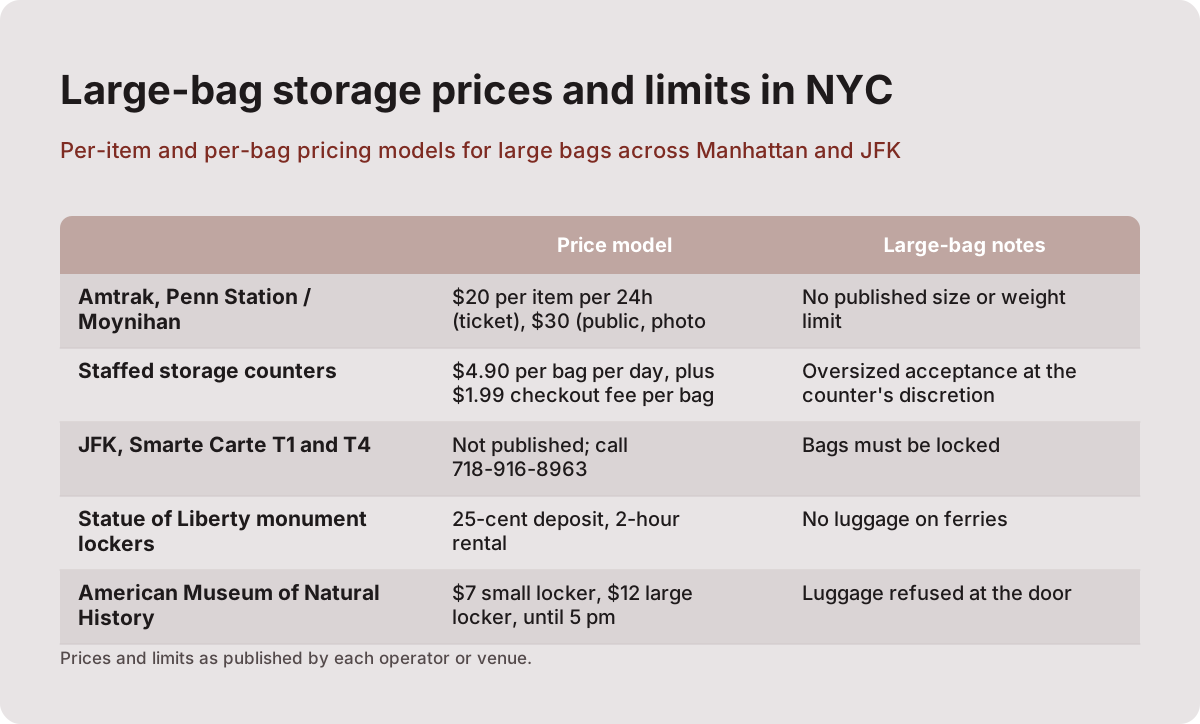
The economics deserve a table, because the pricing models differ in kind, not just amount. Amtrak's counter prices per item per 24-hour period, which makes it the only service whose price does not scale with how many bags you split your load into. The staffed counters also price per bag, so four small bags cost four day-rates while one trunk costs one, which inverts the usual assumption that consolidation saves money. The checkout fee is once per bag, not per night, so one bag for three days runs $16.69 all in at the typical rate.
| Service | Price model | Large-bag notes |
|---|---|---|
| Amtrak, Penn Station / Moynihan | $20 per item per 24h (ticket), $30 (public, photo ID) | No published size or weight limit |
| Staffed storage counters | $4.90 per bag per day, plus $1.99 checkout fee per bag | Acceptance of oversized items at the counter's discretion |
| JFK, Smarte Carte T1 and T4 | Not published; call 718-916-8963 | "Large or small, we store it all"; bags must be locked |
| Statue of Liberty monument lockers | 25-cent deposit, 2-hour rental | Only holds what you carried onto the island; no luggage on ferries |
| American Museum of Natural History | $7 small locker, $12 large locker, until 5 pm | Coats and day bags only; luggage refused at the door |
The museum locker row is the one people misread most often. The American Museum of Natural History genuinely has paid lockers, $7 and $12 per day, and the large size, 22 x 11 x 19.5 inches, is roughly carry-on sized. But the same official document refuses "large bags or back packs or luggage", so the lockers are for coats and day bags, not for the suitcase this article is about. The Statue of Liberty's coin lockers are real too, but the National Park Service is explicit that suitcases and carry-on luggage cannot board the ferries at all, so the lockers only ever hold what you were permitted to carry in the first place.
Which Venue Size Limits Decide Whether You Can Carry The Bag At All?
Nine of the venues this site verified refuse luggage outright, and most publish the exact dimension that triggers the refusal: 22 x 14 x 9 inches at the Guggenheim and Madison Square Garden, 19 x 17 x 8 at the 9/11 Memorial, 25 x 17 x 9 at One World Observatory, 16 x 16 x 8 at Yankee Stadium. A bag bigger than the limit is not just unwelcome, it is unstoreable at six venues with no bag check.
This is the section that turns size rules into a planning decision. The dimensions are not interchangeable, and no venue adopts another's limit, so the only honest presentation is the list itself. The Guggenheim's is the sharpest: items larger than 22 x 14 x 9 inches including handles and wheels "are not permitted in the museum and cannot be checked." One World Observatory answers the airport question directly, no luggage, nothing larger than 25 inches high by 17 wide by 9 deep, and "we do not have lockers or storage capabilities." The Empire State Building, Top of the Rock and SUMMIT One Vanderbilt all refuse luggage and publish no on-site storage. Yankee Stadium's rule is the tightest in the city: one soft-sided MLB-compliant bag no larger than 16 x 16 x 8, all hard-sided bags strictly prohibited, and "there is no storage area for any items at Yankee Stadium."
Broadway deserves its own careful paragraph, because a general answer would be dishonest. The Nederlander Organization's theatres publish an identical block on Broadway Direct: "Bags larger than 20"x14"x9" cannot be checked or allowed inside the theatre. Luggage is prohibited." That is the rule at the Nederlander, the Lunt-Fontanne and the Gershwin, verified word for word on all three. But the Shubert Organization's published theatre policies contain no bag rule at all, so "the Broadway bag policy" does not exist as a single thing. Treat 20 x 14 x 9 as the Nederlander rule and assume nothing about the theatre you are actually attending. The full venue-by-venue detail, including the museums with coat checks, is in NYC museum bag and coat check rules.
| Venue | Published limit (inches) | Luggage | On-site storage |
|---|---|---|---|
| Yankee Stadium | 16 x 16 x 8, soft-sided | Refused | None |
| 9/11 Memorial & Museum | 19 x 17 x 8 | Refused | Coat rooms for visitors |
| Nederlander Broadway theatres | 20 x 14 x 9 | Refused | Not published |
| Madison Square Garden / Radio City | 22 x 14 x 9 | Refused | None |
| Guggenheim | 22 x 14 x 9 incl. wheels | Refused, cannot be checked | Free coat check with admission |
| American Museum of Natural History | Bags over 11 x 17 refused | Refused | Paid lockers, $7 and $12 |
| One World Observatory | 25 x 17 x 9 | Refused | None |
| Empire State Building | Not published | Refused | None |
The Metropolitan Museum of Art is the gap in the table, and the honest treatment is to say it is a gap: the museum's own pages could not be opened and verified, so this site names it only as a museum with a strict bag policy and prints no dimension for it. Do not carry a number from another venue into the Met and expect it to hold.
What Can You Not Leave In A Stored Bag In New York?
Electronics are the surprise: the dominant storage network's terms prohibit storing "Technological material (iPhone, iPad, Tablet, PC, smartphones)" outright, and a prohibited item voids the entire guarantee claim. JFK's counters prohibit flammables, alcohol, firearms and perishables. Amtrak publishes no prohibited-item list for storage but requires locked bags at JFK and photo ID everywhere.
The electronics rule is the one that catches almost everyone, because a bag handed over at a shop counter usually contains a laptop. The terms are unambiguous: technological material is on the prohibited list, and clause 9.8.12 means a prohibited item voids the entire claim. The guarantee itself is EUR 3,000 per bag under the terms, though the marketing pages show different figures, sometimes $10,000, sometimes EUR 10,000, sometimes on the same page. This site reports the terms figure. The claim process has real deadlines too: one week to claim, 48 hours for a police report. None of this is insurance, and the terms say the company may withdraw the guarantee.
Smarte Carte's JFK list is shorter and blunter: no flammable materials, no alcohol, firearms prohibited, perishables prohibited, all bags must be locked, full payment on drop-off, photo ID and boarding pass required, and all bags screened in accordance with TSA safety guidelines. If you are storing at JFK, bring your own lock, because the operator tells you to. There is a fuller treatment of the whole question in what you cannot leave in a stored bag in New York.
| Restriction | Where it applies | Source |
|---|---|---|
| iPhones, tablets, PCs, smartphones | Dominant storage network, all points | Terms, prohibited items clause |
| Prohibited item voids the whole claim | Same network | Terms, clause 9.8.12 |
| Flammables, alcohol, firearms, perishables | JFK Smarte Carte counters | Operator page |
| All bags must be locked | JFK Smarte Carte counters | Operator page |
| Abandoning property | Port Authority Bus Terminal | Terminal rules |
| Bags over 8 hours charged the daily rate | JFK Smarte Carte counters | Operator page |
How Do Ski Bags, Cellos And Other Awkward Items Get Handled?
Awkward is not the same as oversized, and the services that handle awkward best are the staffed ones: Amtrak prices per item with no dimension, JFK's operator says large or small, and the staffed counters make a human call. What no New York option offers is a self-service locker big enough for sporting equipment, because zero of the city's storage points are lockers at all.
A ski bag or a cello case fails at lockers for a structural reason: a fixed aperture cannot admit it. New York has almost no public luggage lockers, and the ones that exist are not luggage options. The Statue of Liberty's coin lockers hold only what you carried past security, and luggage cannot board the ferry. The American Museum of Natural History's largest locker is 22 x 11 x 19.5 inches, which is carry-on territory. NYC Parks genuinely rents lockers at the Central Park Tennis Center, $20 for the whole season, first come first served, but that is a seasonal permit for tennis players, not a bag option. The city's sidewalk locker network, LockerNYC, is explicitly for collecting packages from online orders, in the operator's own words, not for bags.
So an awkward item goes to a person. Amtrak's per-item pricing with no published dimension is the strongest published position in the city for a cello, though the absence of a limit is not a promise: the counter can still decline, and the terms say per item, not per anything. JFK's operator states "Large or small, we store it all", with the conditions already listed. The staffed counters across this site's areas, 88 distinct points, are shops, cafes, hotels and delivery services, and each makes its own call on a ski bag. The practical advice is unchanged: call the specific point before you haul the case across Midtown, and ask two questions, whether they take the item and what they charge per day.
For sporting gear specifically, the venue rules cut the other way and are worth knowing before you store anything. Yankee Stadium's 16 x 16 x 8 soft-sided rule means the ski bag cannot come in regardless of where it spent the morning. Madison Square Garden's 22 x 14 x 9 limit and its statement that it "does not provide an area to check bags, coats or any other personal belongings" make the same point. The plan that works is storage near the venue, visit, retrieve, and the guide to choosing a luggage storage spot in New York walks through that geometry.
Does Weight Matter As Much As Size?
Almost nowhere in New York is weight published for storage. Amtrak's storage prices per item with no weight limit, the staffed counters publish none, and the only weight figures in the record are Amtrak's carry-on rules: 25 lbs for a personal item, 50 lbs per carry-on, with a $20 excess fee per item over the limits. The Port Authority's one-person-one-handcart test is the only weight-adjacent rule at a hub.
The carry-on numbers matter to a different reader, the one storing a bag at Penn before an Amtrak departure and wondering what goes on the train. Amtrak's published carry-on policy allows one personal item, 25 lbs and 14 x 11 x 7 inches, and two carry-ons, 50 lbs and 28 x 22 x 14 inches each, with a $20 excess fee for each item above the quantity and size limits, maximum two excess bags per passenger. Passengers must be able to lift their own carry-ons onto the luggage shelf, and bags must fit in the station sizer. That last sentence decides more large-bag days than any storage rule: if the bag does not fit the sizer, checked baggage or storage is the answer, and checked baggage only works for ticketed passengers between stations that offer it.
The LIRR adds its own luggage rule, published in its City Terminal timetable: "Luggage should be stored in overhead racks and not take up seat space or block the aisles or doorways of trains. Luggage may not be left unattended. Bags and containers are subject to random search by MTA police." That is a behaviour rule, not a weight rule, but "may not be left unattended" is the sentence that pushes a large-bag traveller toward storage in the first place. The full transit treatment, including what the subway does and does not ban, is in taking luggage on the subway and commuter rail.

How Should You Plan A Large-Bag Day In New York?
Plan the bag's whole route, not just its parking spot: match the bag to the venue limit before you leave the hotel, store near the first stop rather than the last, confirm the oversized item by phone or in the booking notes, and keep valuables and electronics out of any stored bag. The MTA's own advice, avoid rush hour with something big, is the best transit timing rule available.
The sequence that fails is the one where the bag discovers a venue limit at the door. A traveller with a 24-inch wheeled bag is fine at the Guggenheim's 22 x 14 x 9 threshold only if the wheels and handles are counted, which the museum explicitly does, so measure the bag the way the venue does, outside dimensions including everything. A traveller heading to Yankee Stadium with any hard-sided bag turns back at the sizer. The venue table above is the pre-flight check.
Geography is the second decision. Storage near the first stop beats storage near the hotel, because the bag should travel the fewest blocks possible. The areas on this site give the spread: Times Square with 44 points suits a theatre-and-Midtown day, Central Park's 33 points ring the park and include the only cheaper rates in the record, $2.90 at two Upper West Side points, and the World Trade Center area's 4 points sit closest to the Memorial's 19 x 17 x 8 limit and One World's 25 x 17 x 9. Penn Station's 27 points are the natural choice for anyone arriving or departing by rail, and the Amtrak counter inside the hub is the fallback that publishes a per-item price.
Two cautions finish the plan. First, electronics: the dominant network's terms prohibit them, so a laptop rides with you or stays home, and the guide to what the guarantee actually covers sets out the claim mechanics. Second, the honest gap: no storage operator in this record publishes a weight limit, so a genuinely heavy trunk is a phone call, not a web search. Ask the counter what they charge, whether the item fits, and whether anyone needs to be there to receive it.
Where Does A Large Bag Fit In The Whole New York Storage Picture?
Large bags are best served by staffed counters and Amtrak's per-item storage, worst served by the city's near-total absence of lockers, and entirely excluded from most venues above dimensions that range from 16 to 25 inches. The one in-hub published price is Amtrak's $20 or $30 per item per 24 hours, and the one citywide network price is $4.90 per bag per day plus the $1.99 fee.
Step back and the shape of the city is clear. New York has one staffed left-luggage counter inside a Manhattan rail hub, airport counters at JFK with unpublished prices, a network of staffed shop counters priced per bag, and no public luggage lockers worth the name. For a large bag that patchwork is mostly good news, because per-item and per-bag pricing does not scale with size and a human at a counter can accommodate a cello in a way a locker never could. The bad news is the venue layer: the bag can be stored all day and still be refused at the door of the Empire State Building, MSG or a Nederlander theatre, limits that no storage booking can waive.
The overnight question is the last one a large-bag traveller should ask, because multi-day storage changes the arithmetic: Amtrak's per-24-hour pricing repeats daily, while the staffed counters charge the day rate per night with the checkout fee once per bag. The full comparison, including what happens when a flight is delayed, is in overnight and multi-day bag storage in NYC.
Hotels are the wildcard this record cannot settle. Named properties publish real policies: Broadway Plaza Hotel stores luggage before check-in and on the day of departure only, no overnight, two bags free and $5.00 per bag after that. The New Yorker charges $5 per bag "for Registered Guests only." Franklin Guesthouse in Brooklyn holds bags for guests before check-in and after check-out. But no New York hotel publishes a policy on holding bags for people who are not staying there, so the honest advice is to ask your own hotel and assume nothing about anyone else's. This site's coverage at Luggage Storage Lockers in New York City exists precisely because the hotel answer is a coin flip.
Common Questions About Large Bag Storage In NYC
Is there a size limit for storing a large bag in New York?
Most staffed storage counters publish no size limit and price per bag, typically $4.90 per day plus a $1.99 checkout fee. Amtrak's Penn Station counter prices per item, $20 or $30 per 24 hours, with no published dimension. Always confirm an oversized item with the specific point before you travel with it.
Can I store a ski bag or sports equipment in New York?
Yes, at a staffed counter. JFK's operator states "Large or small, we store it all", and Amtrak prices per item with no size limit. No New York storage point is a self-service locker, so a person at the counter decides, which is why calling ahead matters for sporting equipment.
Does Amtrak charge more for oversized bags at Penn Station?
Amtrak publishes no size or weight limit for stored bags, only per-item pricing: $20 per item per 24 hours with a valid ticket, $30 for the general public with photo ID. Each additional 24-hour period is charged at the same rate.
Which New York venues refuse large bags outright?
Most of them. The Empire State Building, Top of the Rock, One World Observatory, SUMMIT One Vanderbilt, Madison Square Garden, Radio City, Yankee Stadium, the Guggenheim, the Whitney, the 9/11 Memorial and the Nederlander Broadway theatres all refuse luggage, each at its own published dimension where it publishes one.
Can I store electronics inside my stored bag?
No, not with the dominant storage network. Its terms prohibit "Technological material (iPhone, iPad, Tablet, PC, smartphones)", and a prohibited item voids the entire guarantee claim. Keep laptops and phones with you.
Does luggage weight matter for New York storage?
Almost no storage operator publishes a weight limit. The Port Authority Bus Terminal's rule is that baggage must be carryable by one person with a single handcart, and Amtrak publishes weight limits only for carry-ons on trains, 25 lbs for a personal item and 50 lbs per carry-on, not for stored bags.