Broadway Theater Bag Policy: What You Can Actually Bring Inside
Most Broadway houses publish no bag rule at all. One theatre owner does, and its rule refuses luggage outright, which turns a suitcase into a problem to solve before curtain.
Short answer
Broadway has no single bag policy. The Nederlander Organization publishes the only verified rule: bags larger than 20 x 14 x 9 inches cannot be checked or allowed inside, and luggage is prohibited. Shubert theatres publish no bag rule at all. A ticket holder with a suitcase needs to store it before the show, and Times Square has 44 staffed storage points.
Broadway theatres are old buildings squeezed into mid-block Manhattan real estate, with narrow lobbies, steep stairs and very little room to put anything. That physical reality explains most of what the published rules say, and it explains even more of what the theatres do not say. A traveller arriving at a matinee with a roller suitcase is not an edge case in New York, it is a Tuesday, and the honest answer about what happens at the door depends on which company owns the theatre.
This guide sets out what is actually published, theatre owner by theatre owner, and then walks through the practical problem the rules create: where a bag goes before curtain, how long the gap usually is, and what the drop-off near the theatre district looks like. Everything quoted here comes from the theatre owners' own pages, read directly, and where an owner publishes nothing, that is reported as the finding rather than smoothed over with a guess.
What Is The Broadway Theater Bag Policy?
There is no Broadway-wide bag policy, and no Broadway-wide authority to write one. New York's theatres are owned and operated by several separate companies, and each sets its own rules. One owner, the Nederlander Organization, publishes a bag rule on its theatre pages; another, the Shubert Organization, publishes none. Any page claiming a single Broadway bag policy is describing something that does not exist.
The practical consequence is that a reader cannot look up "the Broadway bag policy" the way they might look up an airport's liquid rules. The question has to be asked per theatre, or more usefully per theatre owner, and even then the answer is often silence. Silence is not permission. A theatre that publishes no rule still has security staff at the door making judgements on the night, and a large suitcase is the kind of item that gets judged.
What can be stated with confidence is narrow and verifiable. The Nederlander Organization's own theatre and ticketing site, Broadway Direct, publishes an identical bag-and-screening block on every theatre page checked, and that block is quoted in full in the next section. The Shubert Organization's published theatre policies, read on its own site, contain no bag rule and no coat-check statement whatsoever. Those two facts together cover a large share of the Broadway houses, and they point in the same direction: assume a suitcase is not getting in, and plan around it.
The gap between "no rule published" and "no rule" is worth pausing on, because it is where most travel content goes wrong. A page that says "Broadway allows small bags" is inventing a standard. A page that says "Broadway bans all bags" is also inventing one. The defensible statement is that one owner publishes a hard dimension and a luggage ban, another publishes nothing, and a ticket holder with anything larger than a day bag should treat storage as part of the plan rather than a problem to argue about at the door.
Which Broadway Theatres Publish A Bag Rule?
The Nederlander Organization publishes the only verified bag rule among Broadway theatre owners. On its Broadway Direct pages, every theatre checked carries the identical wording: all bags are inspected on arrival, bags larger than 20 x 14 x 9 inches cannot be checked or allowed inside, and luggage is prohibited. Shubert theatres publish no bag rule at all, so the rule depends entirely on which company owns the house.
The Nederlander rule, verified word for word on the Nederlander, Lunt-Fontanne and Gershwin theatre pages on Broadway Direct, reads: "Bag Screening: All bags will be inspected upon arrival. Bags larger than 20"x14"x9" cannot be checked or allowed inside the theatre. Luggage is prohibited." The same pages add: "Do not leave your personal bags (purses, backpacks) unattended while in the theatre." The prohibited-items list on those pages ends with the single word "Luggage".
| Source | What is published | What it means for a ticket holder |
|---|---|---|
| Broadway Direct, Nederlander theatre pages | Bags over 20 x 14 x 9 inches refused; luggage prohibited; all bags inspected | A suitcase cannot enter and cannot be checked; store it before arrival |
| Broadway Direct, Lunt-Fontanne page | Identical wording, checked separately | Same rule across Nederlander houses |
| Broadway Direct, Gershwin page | Identical wording, checked separately | Same rule across Nederlander houses |
| Shubert Organization, Majestic theatre policies | Camera, phone, food, weapons and age rules; no bag rule, no coat check | No published dimension; door staff decide on the night |
Two cautions belong beside that table. First, the phrase "cannot be checked or allowed inside" implies smaller bags can be checked somewhere, but the pages publish no coat-check fee, no location and no hours, so no claim can be made that a checkroom exists. Second, the Shubert policies block, read in full on the company's own site, covers cameras, recording devices, tickets, latecomers, wheelchair seating, children, outside food and weapons, and says nothing about bags of any size. That is a genuine absence, not an oversight this site is entitled to fill.
For a ticket holder, the working assumption is simple: whatever the house, a suitcase is not part of the plan. The Nederlander rule says so explicitly for its theatres, and nothing in the Shubert policies suggests a more generous reading. The bag needs a place to go before the doors open, and the theatre district happens to sit inside the densest storage coverage in this site's inventory.
Times Square is where most Broadway theatres actually are, and the storage coverage there is the deepest of the eight areas this site publishes: 44 staffed storage points within 800 metres of the Times Square anchor, rated 4.79 across 2,400 reviews, at a typical $4.90 per bag per day plus the $1.99 per-bag checkout fee. Every one of those points is a staffed counter at a shop, cafe or hotel, not a self-service locker, so a human takes the bag, tags it and hands back a receipt. You can check the storage points around Times Square directly, or Check availability for the evening you need.
Can You Check A Suitcase At A Broadway Theatre?
No Broadway theatre publishes a luggage check service, and the one owner that publishes anything about checking bags states that oversized bags cannot be checked at all. The Nederlander wording, "cannot be checked or allowed inside", is the strongest published statement in either direction. No Shubert page, and no Nederlander page, names a coat check, a fee or a storage room for suitcases.
This is one of those questions where the absence of evidence really is the finding. Theatre checkrooms do exist in New York, but the ones this site has verified are in museums, not theatres: the Guggenheim checks coats and small bags free with admission, the Whitney runs a complimentary coat check on Floor -1, and the 9/11 Memorial and Museum provides coat rooms for visitors' belongings during a visit. Those are covered in the guide to NYC museum bag and coat check rules, and none of them applies to a theatre, nor do any of them accept luggage. The Whitney's own policy says "luggage of any size or type is prohibited", and the Guggenheim refuses items larger than 22 x 14 x 9 inches outright, including handles and wheels.
So the suitcase a traveller brings to New York is refused, or at least unwelcome, at an entire chain of venues that a typical itinerary strings together: the theatre, the museums, the observation decks, the stadiums. The Empire State Building publishes "no locker or storage facilities available on-site", One World Observatory states it has no lockers or storage capabilities, and Yankee Stadium's policy ends with "there is no storage area for any items at Yankee Stadium". Anyone touring the city before a night flight is carrying a bag almost nothing will accept, which is the situation our Luggage Storage Lockers in New York City coverage exists to solve, area by area.
The timing question matters as much as the location question. Matinees typically start in the early afternoon and evening performances in the evening, with doors opening shortly before curtain, and a bag drop has to happen before that window. Because every Times Square-area point is staffed, the drop itself takes minutes: the counter tags the bag, the traveller keeps a receipt, and pickup happens after the show lets out, when the streets around the theatres are at their most crowded. Picking a point a block or two from the theatre, rather than the closest one to the subway exit, is usually the difference between a calm walk back and a long line.
What Bag Sizes Are Allowed In New York Theatres And Venues?
The only published Broadway dimension is the Nederlander limit of 20 x 14 x 9 inches, with luggage prohibited regardless of size. Other New York venues publish their own numbers: Madison Square Garden and Radio City use 22 x 14 x 9 inches, One World Observatory allows up to 25 x 17 x 9 inches, and Yankee Stadium allows one soft-sided bag of 16 x 16 x 8 inches. Each rule belongs to its own venue.
The spread is the point. A bag that fits One World Observatory's limit can still be refused at the Gershwin. A bag that squeaks into Madison Square Garden can be turned away at Yankee Stadium, where hard-sided bags are prohibited outright and sizers are used at the gates. There is no city-wide dimension to plan around, only a list of per-venue rules, and the safest planning assumption for a theatre evening is the strictest one in the set.
| Venue | Published size limit | Luggage | On-site storage |
|---|---|---|---|
| Nederlander Broadway theatres | 20 x 14 x 9 inches | Prohibited | Not published |
| Shubert Broadway theatres | None published | Not published | Not published |
| Madison Square Garden | 22 x 14 x 9 inches | Refused in practice | None, per its FAQ |
| Radio City Music Hall | 22 x 14 x 9 inches | Refused in practice | None, per its FAQ |
| One World Observatory | 25 x 17 x 9 inches | Not allowed | None, per its FAQ |
| Yankee Stadium | 16 x 16 x 8 inches, soft-sided only | Hard-sided prohibited | None, per its policy |
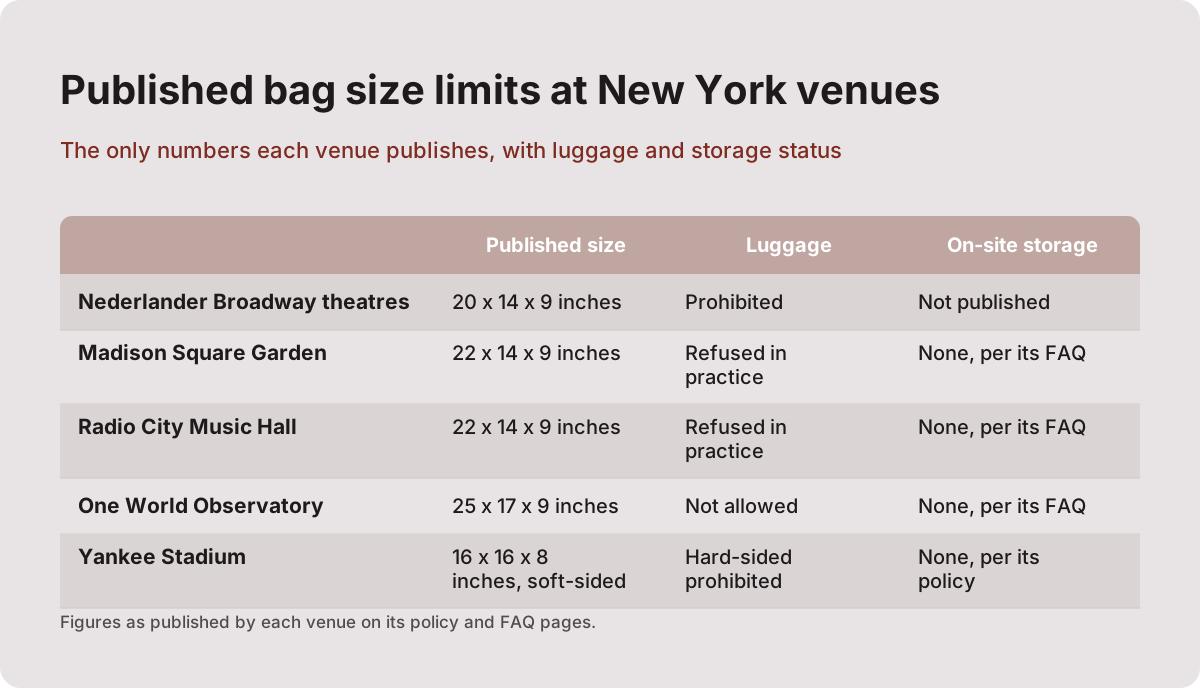
Two cautions on reading that table. Madison Square Garden's current FAQ page renders its answers by script, so its baseline rule, bags larger than 22 x 14 x 9 inches prohibited with no area to check bags, coats or belongings, stands as last read rather than re-verified, and it is not contradicted. And the Shubert row genuinely contains nothing: the company publishes no dimension, so the honest entry is "none published", not a number borrowed from another owner. The full venue-by-venue detail, including the museums and observation decks, is in the guide to observation deck and monument bag rules.
For a reader deciding what to carry to the theatre, the Nederlander numbers are the practical ceiling. A day bag or a soft tote under 20 x 14 x 9 inches, with nothing that reads as luggage, is the profile that passes inspection at every house in the table. Anything bigger, anything wheeled, anything that looks like it was packed for a flight, belongs in storage before the show, not in a negotiation with a security guard while the house lights go down.
Where Do You Store Luggage Before A Broadway Show?
Times Square carries the deepest storage coverage of the eight areas this site publishes: 44 staffed points within 800 metres, rated 4.79 across 2,400 reviews, at a typical $4.90 per bag per day plus a $1.99 per-bag checkout fee. Midtown Manhattan adds 16 more points, and every point is a staffed counter, not a locker. The rate to expect is $4.90, and the advertised $2.90 floor applies almost nowhere near the theatres.
The staffed-counter detail is worth understanding before booking, because it shapes the whole experience. There are no self-service lockers in the New York storage network this site measures: zero of the 178 Radical Storage points in New York City is a locker, and the place-type breakdown runs to shops, cafes, convenience stores, delivery services, restaurants and hotels. That means a person at the counter, a tag on the bag and a receipt in hand, which also means published opening hours matter. In Times Square, 42 of the 44 points publish hours, and picking a point whose hours cover both the drop before curtain and the pickup after the show lets out is the single most important filter.
The pricing arithmetic is straightforward and worth doing before booking. One bag for one day costs $6.89 all in: the $4.90 day rate plus the $1.99 checkout fee, which is charged once per bag rather than per night. Three days for one bag comes to $16.69, because the fee does not repeat. Radical Storage's own New York page now states plainly that its $2.90 figure is "the lowest currently available city price, not a promise that every location or bag category has the same rate", and this site's own measurement found $4.90 on 168 of 178 point cards, so $4.90 is the honest number to plan on. A cheaper $2.90 rate does exist near Central Park, at the 72nd Street Subway Station and Cathedral Parkway / 110th Street points, and nowhere else.
| Area | Points within 800 m | Rating | Reviews | Points publishing hours |
|---|---|---|---|---|
| Times Square | 44 | 4.79 | 2,400 | 42 |
| Midtown Manhattan | 16 | 4.7 | 596 | 15 |
| Central Park | 33 | 4.79 | 762 | 33 |
| Brooklyn | 11 | 4.82 | 79 | 11 |
That table is the planning map for a theatre day. Times Square wins on density, which matters when the curtain time is fixed and the walk back after the show should be short. Midtown adds coverage a few blocks east and south, useful for a theatre on the side streets. Central Park and Brooklyn serve the itineraries that start or end away from the theatre district, and their smaller counts mean fewer choices of hours, so checking availability early matters more there.
That Central Park exception matters for a particular kind of theatre day: the matinee-plus-park itinerary. A traveller staying uptown, or planning a morning walk through the park before an afternoon show, can drop the bag at one of those two cheaper points, spend the morning around the park, and ride down to the theatre district with nothing but a small bag. Central Park's area carries 33 storage points within 800 metres of its anchor, rated 4.79 across 762 reviews, with all 33 publishing hours. The trade is distance: the cheap points sit far uptown of the theatres, so the plan only works if the park is genuinely on the route.
For a Brooklyn-based traveller, the same logic applies in reverse. A visitor staying in Williamsburg or Brooklyn Heights who wants an evening show faces a choice: carry the suitcase into Manhattan and back on a crowded train, or drop it near the bridge before heading to the theatre. Brooklyn's area carries 11 staffed points within 800 metres of its anchor, rated 4.82 across 79 reviews, all 11 publishing hours, at the same typical $4.90 per bag per day plus the $1.99 fee. The numbers are smaller than Manhattan's, which is itself useful information: 11 points means less choice on hours and location, so checking availability before committing to the day matters more, not less.
How Does A Matinee Day With A Suitcase Actually Work?
The reliable pattern is: drop the bag at a staffed point within walking distance of the theatre before doors open, carry only a small day bag to the show, and collect the suitcase after the curtain. With a $4.90 day rate and a $1.99 fee, one bag for one theatre day costs $6.89 all in, and the pickup point's closing time, not the curtain time, is the constraint that decides which point to book.
Start from the show time and work backwards. Doors open shortly before curtain, so the drop has to happen earlier, and the pickup happens two to three hours after that for a straight play, longer for a musical with an interval. A point that closes at six in the evening is useless for an eight o'clock show no matter how close it sits to the theatre. In Times Square, 42 of the 44 points publish hours, so the filter is easy to apply; the guide to 24 hour and late night luggage storage in NYC covers the subset that runs around the clock for anyone whose plans run later than the standard closing times.
Then think about what stays with you. The Nederlander rule inspects every bag on arrival, so the day bag itself gets searched, and anything that reads as luggage, wheeled, hard-sided or oversized, ends the evening before it starts. What works is a soft tote or backpack well under 20 x 14 x 9 inches, holding the phone, the ticket, a layer for the air conditioning and nothing else. The prohibited-items list on the Nederlander pages ends with the single word "Luggage", which is about as unambiguous as theatre rules get.
One expectation worth setting before booking, reported honestly from traveller reviews: a reader books an area and a point type, and the exact street address is confirmed through the booking. A recent review on the operator's review page complains that the company "refuses to share even an approximate storage address until AFTER you've paid", and while that is one person's experience rather than a statistic, it matches how the booking flow works. The practical response is to check availability early in the day, confirm the point's hours against the curtain time, and not leave the drop to the last minute before doors.
What If The Show Is Not The Only Thing On The Itinerary?
A theatre ticket usually sits inside a bigger day, and the same stored bag has to survive every stop around it. New York's museums refuse luggage outright, most observation decks publish no storage of any kind, and the subway's only hard dimension, thirty inches, applies to wheeled carts rather than suitcases. One booking near the theatre can cover the whole day, provided the point's hours span the last stop, not just the show.
The MTA's own rider guide tells travellers: "Don't travel with more than you can carry on your own, and avoid rush hour if you're transporting something big." That is the agency itself saying, in its own words, that dragging an oversized bag through the system is a bad plan, and the rulebook backs it with real fines: obstruction of seating, facilities, elevators or escalators carries a $50 fine, and obstruction of operations or traffic carries $100. The only measurement in the subway rules, thirty inches in either length or width, applies to wheeled carts, not luggage, so there is no suitcase size limit as such, only behaviour tests and the agency's blunt advice not to carry more than you can manage.
That advice is the strongest argument for storing the bag once and planning the day around the booking. A traveller with a matinee ticket, a museum booked for the morning and dinner after the show has three venues that all refuse or discourage the suitcase, and one storage booking solves all three. The guide to Madison Square Garden's bag policy covers the same problem for the concert and game crowd, and the same Times Square and Midtown points serve both, since the arena sits a short walk from the theatre district. Midtown Manhattan carries 16 points within 800 metres of its own anchor, rated 4.7 across 596 reviews, on top of Times Square's 44.
The one thing not to do is park the bag somewhere unofficial. The unattended-item rules that do exist in New York are about leaving property, not storing it: the Staten Island Ferry's rules forbid leaving property unattended in terminals or on ferries, the LIRR's timetable states luggage may not be left unattended and is subject to random search, and the 9/11 Memorial's guidelines state unattended bags will be subject to search and removal. None of that is a storage service, and none of it turns a bench or a locker room that does not exist into one. The staffed counter with a receipt is the option that actually exists.
Common Questions About Broadway Theatre Bag Rules
Is there a single Broadway theater bag policy?
No. Broadway theatres are owned by separate companies that set their own rules. The Nederlander Organization publishes a bag rule on its theatre pages; the Shubert Organization publishes none. Any single "Broadway bag policy" claimed elsewhere is an invention.
What size bag can I bring into a Broadway theatre?
At Nederlander houses, the published limit is 20 x 14 x 9 inches, with all bags inspected on arrival and luggage prohibited regardless of size. At Shubert theatres, no dimension is published, so door staff decide on the night. A soft day bag well under 20 x 14 x 9 inches is the safe profile at any house.
Can I check a suitcase at a Broadway theatre?
No Broadway theatre publishes a luggage check service. The Nederlander wording states oversized bags "cannot be checked or allowed inside", and no Shubert page names a coat check, a fee or a storage room. A suitcase has to be stored elsewhere before the show.
Where do I store luggage before a Broadway show?
Times Square carries 44 staffed storage points within 800 metres, rated 4.79 across 2,400 reviews, at a typical $4.90 per bag per day plus a $1.99 checkout fee. Midtown Manhattan adds 16 more points. Every point is a staffed counter, so check the point's published hours against your curtain and pickup times.
Do Shubert theatres allow bags?
Shubert publishes no bag rule at all. Its published theatre policies cover cameras, phones, tickets, latecomers, seating, children, food and weapons, and say nothing about bag sizes or coat checks. That is an absence of a rule, not permission to bring a suitcase, and door staff make the call on the night.
How much does it cost to store a bag for a theatre day?
One bag for one day costs $6.89 all in: the $4.90 day rate plus the $1.99 per-bag checkout fee, charged once per bag rather than per night. The advertised $2.90 figure is a citywide floor that the operator itself disclaims as a promise, and it applies near Central Park at only two points.