Empire State Building Bag Policy And Observation Deck Luggage Rules
Every major New York observation deck screens bags at the door, and most of them refuse suitcases outright. The Empire State Building, One World Observatory, Top of the Rock and the Statue of Liberty ferry each publish their own rule, and the numbers differ from venue to venue. This guide collects the published policies in one place, then covers where a refused bag can actually go.
Short answer
The Empire State Building prohibits large bags, suitcases and carry-on luggage, and its own FAQ states there are no locker or storage facilities on site. One World Observatory allows bags only up to 25 x 17 x 9 inches. The Statue of Liberty refuses luggage on the ferry entirely. Staffed bag drops near the decks typically cost $4.90 per bag per day plus a $1.99 checkout fee.
Security screening is the first queue you stand in at every New York observation deck, and it is where a suitcase ends the visit. The Empire State Building says so in plain words on its own FAQ page. So does One World Observatory. So does the National Park Service at the Statue of Liberty, which will not let a suitcase onto the ferry at all, let alone up the monument. The rules differ in the details, and the details are what decide whether you get in.
This guide walks through each venue's published policy in turn, with the size limits quoted from the operators themselves. It then covers the practical question that follows: if the bag cannot go up, where does it go? For the wider museum picture, including the American Museum of Natural History's paid day lockers, see the companion NYC museum bag and coat check rules guide.
What Is The Empire State Building Bag Policy?
The Empire State Building prohibits large bags, suitcases, carry-on luggage and oversized packages, and its own FAQ states there are no locker or storage facilities on site for personal belongings. No permitted-bag size limit is published, and there is no coat check, so a suitcase is a refused-entry problem at security rather than a comfort problem at the top.
The building's FAQ lists "large bags, suitcases, carry-on luggage, or oversized packages" among its prohibited items, then adds the sentence that matters most to anyone travelling with a case: "Please note: There are no locker or storage facilities available on-site for personal belongings." That is the operator speaking, on its own official FAQ page. There is no ambiguity to interpret and no discretion to appeal to. If the bag does not pass the prohibited-items list, the visit does not happen.
Two practical points follow from the wording. First, the building publishes no dimension for what counts as a "large bag", unlike One World Observatory or the 9/11 Memorial, which both print exact numbers. That means the judgement at the door is a security guard's judgement, and the safe assumption is that anything wheeled or carry-on sized will be turned away. Second, the building is on 34th Street at Fifth Avenue, in the middle of the densest storage coverage in the city. A staffed bag drop in the Midtown Manhattan area, listed here with hours and ratings, sits within walking distance of the entrance, and the typical rate is $4.90 per bag per day plus a $1.99 per-bag checkout fee.

The timing matters as much as the rule. Deck queues at the Empire State Building are longest from late morning through late afternoon, and standing in a security line with a suitcase you already know will be refused wastes the better part of an hour. Drop the bag first, then queue. The building's own advice to arrive early and travel light is the same advice the security line will give you, delivered before you have spent the ticket money instead of after.
One more thing worth knowing: the prohibition is on the person, not the bag. There is no option to pay a fee and check the case inside the building, because the FAQ sentence covers lockers and storage facilities of every kind. Nothing in the published policy suggests an exception, and nothing in the research record found one offered at the door.
Can You Bring A Suitcase To One World Observatory Or Top Of The Rock?
One World Observatory permits only bags no larger than 25 inches high, 17 inches wide and 9 inches deep, and publishes that it has no lockers or storage capabilities for personal items. Top of the Rock is blunter still: large bags and luggage are not permitted, and storage is not available on site. Both decks therefore refuse suitcases at entry, and neither offers anywhere to leave one.
One World Observatory answers the question directly on its own FAQ page, in a question aimed squarely at visitors heading to the airport: "We are visiting prior to going to the airport; can we bring our luggage with us? No, luggage is not allowed in the Observatory." The size limit for what is allowed, 25 inches high by 17 wide by 9 deep, is generous by handbag standards but well below any wheeled suitcase. The page also reserves the right to refuse entry to any article at its discretion, which means even a permitted-size bag can be turned back if security decides otherwise.
Top of the Rock, up at Rockefeller Center, publishes a shorter version of the same rule. Its planning FAQ states that large bags and luggage are not permitted and that storage is not available on site. No dimension is published, so the same caution applies as at the Empire State Building: the absence of a printed number is not permission, it is a judgement call made at the door, and a suitcase loses that judgement every time.
The two decks' rules sit side by side in the table below, with the Empire State Building included for comparison. Note how differently the three operators handle the same problem: one bans categories of bag without a number, one prints a precise dimension, and the third, covered later, moves the problem off the premises entirely by refusing luggage at a ferry terminal miles away.
| Venue | Published size limit | Luggage refused? | On-site storage? |
|---|---|---|---|
| Empire State Building | None published for permitted bags | Yes, in prohibited items | No, stated in FAQ |
| One World Observatory | 25" h x 17" w x 9" d | Yes | No, stated in FAQ |
| Top of the Rock | None published | Yes | No, stated in FAQ |
| SUMMIT One Vanderbilt | None published as a dimension | Yes, suitcases named | Not mentioned |
The pattern is consistent enough to plan around. No Manhattan observation deck publishes a locker, a coat check that takes suitcases, or a paid bag room. Every one of them either names luggage in its prohibited items or applies a dimension that luggage cannot meet. A traveller with a case needs an off-site answer, and the sections below get to those, but the deck rules themselves leave no wiggle room.
For the Lower Manhattan visitor, the World Trade Center area is where this bites hardest, because One World Observatory is the attraction and the immediate neighbourhood publishes only four staffed storage points within 800 metres. The World Trade Center bag drop options are worth checking before you set out, since the choice there is thin compared with Midtown.
Does The Statue Of Liberty Have Lockers?
The Statue of Liberty has real coin lockers, but only at the entrance to the monument on Liberty Island, rented for 2 hours with a 25-cent deposit, quarters only. There are no lockers at the screening facilities at either ferry terminal, and suitcases and carry-on luggage are not permitted on the ferries or on either island at all. The lockers hold what you carried over; they are not luggage storage.
The National Park Service spells the two halves of this out on its own safety page. First, the negative: "There are NO locker storage areas at the screening facilities in either The Battery or Liberty State Park." Second, the ferry rule: "Suitcases, carry-on luggage, and other, large parcels will not be permitted on the ferry systems or at Liberty and Ellis Islands." A traveller who arrives at the terminal with a suitcase has no locker, no left-luggage counter and no storage option of any kind on the Manhattan or New Jersey side.
The lockers that do exist sit at the entrance to the monument itself, after the ferry, and they exist for a specific reason. Visitors with Crown or Pedestal tickets pass a secondary security screening similar to airport procedures, and Crown ticket holders are permitted to carry only a camera, a mobile phone, water in a clear container and necessary medication. Everything else, the Park Service says, must be stored in lockers. The lockers rent for 2 hours, require a 25-cent deposit in quarters, and a change machine is on site.
| Statue of Liberty locker fact | Published detail |
|---|---|
| Location | At the entrance to the monument, Liberty Island |
| Rental period | 2 hours |
| Cost | 25-cent deposit, quarters only |
| Change machine | Yes, on site |
| Lockers at ferry terminals | None, stated by the Park Service |
| Suitcases on ferries | Not permitted |
These are the only genuine public coin lockers verified anywhere in New York City, and it is worth being precise about why they do not solve a luggage problem. The monument lockers hold the small things you carried onto the island, because luggage could not board the ferry in the first place. They are a security feature of the Crown screening, not a left-luggage service, and the 2-hour window matches a monument visit, not a day of sightseeing. Anyone who tells you to "use the lockers at the Statue of Liberty" for a suitcase has not read the ferry rule.
The practical consequence is that the Battery, at the southern tip of Manhattan, is the decision point. A suitcase has to be dropped before the ferry terminal, not at it. The same Lower Manhattan storage thinness that affects One World Observatory visitors applies here, since the World Trade Center area and the ferry terminals sit within the same few blocks, so booking a staffed point ahead of the morning ferry is the move that keeps the day on schedule.
How Do The 9/11 Memorial And Monument Rules Compare?
The 9/11 Memorial permits no baggage larger than 19 inches by 17 inches by 8 inches onto the Memorial, and the Museum requires oversized items to be stored in its Coat Rooms during a visit. Unattended bags anywhere on the property are subject to search and removal. The Coat Rooms are the one place in this whole guide that takes large items off your hands, but only for the duration of your visit.
The Memorial's visitor guidelines set the dimension twice, phrased as "no baggage larger than 19 inches by 17 inches by 8 inches deep will be permitted onto the Memorial", with permissible items limited to 8 x 17 x 19 inches per item. The Museum's rules then go further under a heading the guidelines call "Mandatory Baggage Storage & Storage Services": all visitors must store large bags, backpacks, large umbrellas and anything staff deem too large or a danger to the exhibits, and the Museum provides storage in Coat Rooms on the Concourse Lobby level and the Pavilion Auditorium level. No fee for the Coat Rooms is published, and none was found, so the honest answer on cost is that the guidelines do not state one.
There is a hard edge to the same document. At the discretion of security staff, the Memorial Museum may not admit, nor provide storage for, visitors' large personal items, and unattended bags found anywhere on the property will be subject to search and removal. That last sentence is the operational reality behind every "do not leave your bag" rule in this guide: the venue is not minding it for you, and anything left may be gone when you return.
Set beside the decks, the 9/11 Memorial is the outlier in a useful way. It is the only venue here that both refuses large bags and provides somewhere to put them, however temporarily. The Empire State Building refuses and provides nothing. One World Observatory refuses and provides nothing. The Statue of Liberty refuses at the ferry and provides lockers only for what survived the ferry rule. The Memorial splits the difference, and a visitor with one large backpack can still see the Museum provided they accept the Coat Room condition and the possibility of a discretionary refusal.
The size limits across all these venues are not interchangeable, and the infographic below puts them side by side. The differences are large enough to matter: a bag that clears the 9/11 Memorial's 19-inch rule can still fail One World Observatory's 25 x 17 x 9, and a soft-sided bag that fits Yankee Stadium's 16 x 16 x 8, covered in the Yankee Stadium bag policy guide, is smaller than all of them. Never carry one venue's number to another venue's door.
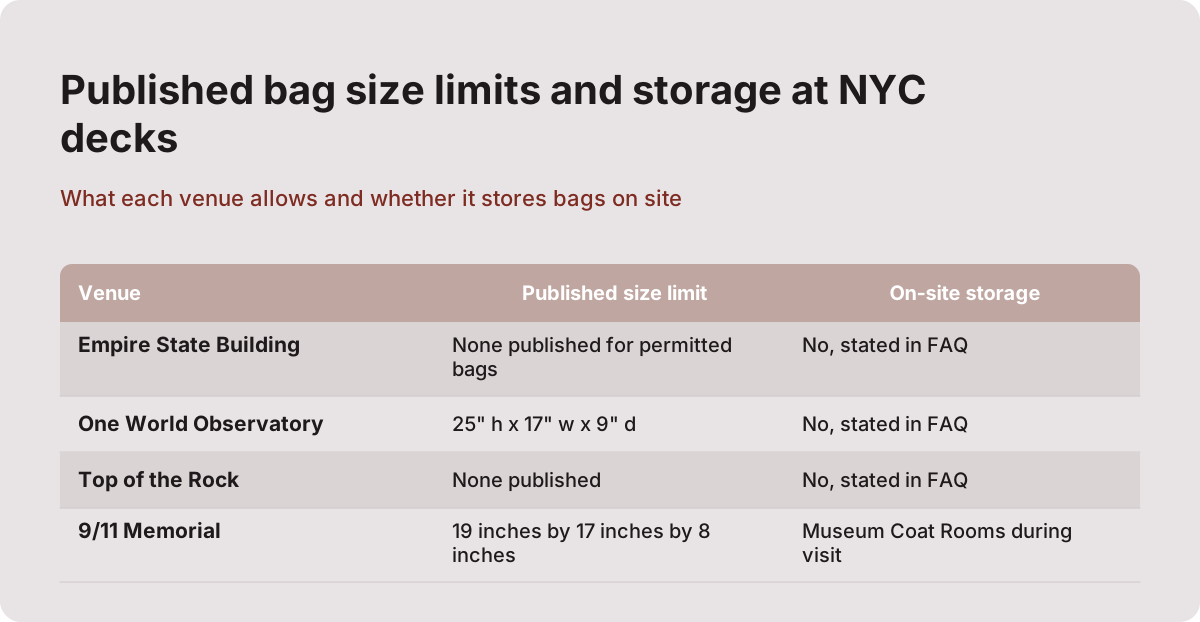
For visitors combining the Memorial with One World Observatory, the geography is kind: the two sites sit a short walk apart in Lower Manhattan, and a single bag drop covers both. The staffed points around the World Trade Center are the thinnest cluster in the city at four within 800 metres, but they exist, they publish hours, and they hold a bag for the day rather than for the length of one visit.
What About SUMMIT One Vanderbilt And The Newer Decks?
SUMMIT One Vanderbilt prohibits suitcases, trunks, wheeled duffle bags, carry-on bags and any container larger than a standard backpack, purse or messenger bag, and publishes no dimension, no locker and no storage for them. Newer decks keep arriving, including a municipal observation deck that opened in June 2026, and the pattern holds: none of them wants your suitcase.
SUMMIT's rule is the broadest catch-all in the set. Where other venues print a dimension, SUMMIT names categories and a comparison standard: anything larger than a normal backpack, purse or messenger bag is prohibited, and all containers are subject to search by the security team. No locker, coat check or storage option appears anywhere on its published pages. A carry-on suitcase is named explicitly, so there is no reading of the rule under which it gets in.
The newest deck is a city-run one. The Department of Citywide Administrative Services announced the opening of Centre 360 at the David N. Dinkins Municipal Building at 1 Centre Street, a cupola viewing space some 500 feet above street level offering 360-degree views of Lower Manhattan, described in the City's own release as its new and only municipal observation deck. The release publishes no bag or luggage rule. That is not permission to bring a suitcase; it is an unpublished policy, and the sensible assumption given every other deck in this guide is that luggage will be refused. Watch the venue's own pages for a published rule before counting on anything.
SUMMIT's location shapes the storage answer. It sits directly above Grand Central Terminal, which has no left-luggage service of its own, a fact covered in full in the Penn Station vs Grand Central vs Port Authority comparison. The nearest dense cluster of staffed points is the Times Square area, a ten-minute walk west, with 44 storage points within 800 metres, rated 4.79 across 2,400 reviews, at the typical $4.90 per bag per day plus the $1.99 checkout fee. Grand Central's own FAQ, for the record, answers the storage question flatly: there are no luggage storage services at Grand Central.
The lesson from the newer decks is that the rule set is stable even as the skyline changes. A deck opens, it screens bags, it refuses luggage, and it offers nowhere to put it. Centre 360's silence aside, nothing in the published record suggests any observation deck in New York has added a locker bank, a checkroom or a storage concession. Planning around the absence is faster than discovering it at a security table.
Where Do You Put The Bag Instead?
Staffed bag drops are the working answer, and in New York they cluster around the decks that refuse luggage. Typical pricing runs $4.90 per bag per day plus a $1.99 per-bag checkout fee, so one bag for one day costs $6.89 all in. Every point is a staffed counter, not a locker, and the areas near the major decks publish their hours up front.
The economics are worth stating plainly because the advertised "from" price understates what a New York booking actually costs. Radical Storage's own New York page now carries a disclaimer in its own words: the $2.90 figure is "the lowest currently available city price, not a promise that every location or bag category has the same rate". The measured reality is that the overwhelming majority of New York point cards show $4.90, and the $1.99 checkout fee is added per bag at payment, once, not per night. Three days for one bag is $16.69 all in.
Choosing a point is mostly geography, and the deck map makes it simple. Midtown decks, the Empire State Building and SUMMIT, sit inside the two densest clusters: Times Square with 44 points and Midtown Manhattan with 16. Lower Manhattan's World Trade Center area has four, which is thin, so booking ahead matters more there than anywhere. Central Park's perimeter spread runs to 33 points, and it carries the one genuine price break in the city: two points, at the 72nd Street Subway Station and at Cathedral Parkway / 110th Street, charge $2.90 per bag per day, and no other point does.
| Area | Points within 800 m | Typical rate per bag per day | Notes |
|---|---|---|---|
| Times Square | 44 | $4.90 | Closest dense cluster to SUMMIT and Midtown decks |
| Midtown Manhattan | 16 | $4.90 | Walking distance of the Empire State Building |
| World Trade Center | 4 | $4.90 | Thin coverage, book ahead for One World and the Battery |
| Central Park perimeter | 33 | $4.90, with $2.90 at two named points | The only sub-$4.90 points in the city |
Two cautions from the research record apply to any booking. The operator's terms prohibit storing electronics, naming iPhones, iPads, tablets, PCs and smartphones outright, so a laptop travels with you or stays home; the what you cannot leave in a stored bag guide covers the full list. And a booking reserves a point in an area rather than a specific street address, which recent guest reviews on Trustpilot confirm: one detailed complaint notes the company "refuses to share even an approximate storage address until AFTER you've paid". Expect an area and a walking time, not a door number, until the booking is made.
The guarantee question gets a straight answer too. The binding terms cover each bag for a value of EUR 3,000, with a per-claim cap of the same amount, while the marketing pages advertise a figure that appears nowhere in the terms and is printed in two different currencies on the same page. The guarantee is not insurance, claims carry a one-week deadline and a 48-hour police-report deadline, and a prohibited item voids the entire claim. The Radical Storage guarantee coverage guide walks through every clause.
For the free-option question, the honest answer is on the free luggage storage in New York page: the only genuinely free holds are the courtesy bag desks hotels run for their own guests, and hotel policies vary widely. Broadway Plaza Hotel, for instance, stores up to two bags per guest free before check-in and on departure day only, charges $5 per bag beyond that, and refuses overnight holds. The New Yorker charges $5 per bag and restricts its storage to registered guests. No New York hotel publishes a policy on holding bags for people who are not staying there, so a non-guest has no entitlement and it is entirely at the hotel's discretion.
The last-day version of this problem, a bag, a night flight and a deck you want to see on the way out, has its own rhythm, and the last day in New York before a night flight guide lays out the sequencing. The short version: drop the bag at a staffed point near your first stop in the morning, see the decks unencumbered, and collect on the way to the airport. It beats dragging a suitcase through a security table that was going to refuse it anyway.
This is the picture Luggage Storage Lockers in New York City was built to give: every deck's published rule, every size limit quoted from the operator, and a staffed, priced, hours-published alternative for the bag the deck will not take. The city's lockers, where they exist at all, are at a tennis centre, a museum coat area and a national monument, and none of them is a luggage option. The staffed counters are.
Common Questions About Observation Deck And Monument Bag Rules
What is the Empire State Building bag policy?
The Empire State Building prohibits large bags, suitcases, carry-on luggage and oversized packages, and its own FAQ states there are no locker or storage facilities on site for personal belongings. No size limit for permitted bags is published, so anything wheeled or carry-on sized should be assumed refused at security.
Can you bring a suitcase to One World Observatory or Top of the Rock?
No. One World Observatory allows only bags up to 25 inches high, 17 inches wide and 9 inches deep and states it has no lockers or storage capabilities. Top of the Rock does not permit large bags or luggage and states that storage is not available on site.
Does the Statue of Liberty have lockers?
Yes, but only at the entrance to the monument on Liberty Island, rented for 2 hours with a 25-cent deposit in quarters. There are no lockers at the ferry terminal screening facilities, and suitcases and carry-on luggage are not permitted on the ferries or on either island at all.
How do the 9/11 Memorial and monument rules compare?
The 9/11 Memorial permits no baggage larger than 19 x 17 x 8 inches onto the Memorial, and the Museum requires oversized items to be stored in its Coat Rooms during a visit, at no published fee. It is the only venue in this guide that both refuses large bags and provides somewhere to put them, though security may decline either admission or storage at its discretion.
What about SUMMIT One Vanderbilt and the newer decks?
SUMMIT prohibits suitcases, trunks, wheeled duffle bags, carry-on bags and any container larger than a standard backpack, purse or messenger bag, and publishes no storage option. Newer decks follow the same pattern, and the municipal Centre 360 deck that opened in June 2026 publishes no bag rule at all, so assume luggage is refused until it says otherwise.
Where do you put the bag instead?
Staffed bag drops cluster around the decks: 44 points within 800 metres of Times Square, 16 around Midtown Manhattan and 4 around the World Trade Center. The typical rate is $4.90 per bag per day plus a $1.99 per-bag checkout fee, so one bag for one day costs $6.89 all in. Every point is a staffed counter, not a locker, and electronics are prohibited in stored bags by the operator's terms.