Yankee Stadium Bag Policy: Sizes, Exceptions And Where To Leave A Bag
The Yankees allow one small soft-sided bag per guest and publish, in their own words, that there is no storage area for any items at Yankee Stadium. A traveller arriving with a suitcase has to solve the problem before the gates.
Short answer
Yankee Stadium permits one MLB-compliant bag, soft-sided and no larger than 16 x 16 x 8 inches, plus one smaller soft-sided personal item. Hard-sided bags are strictly prohibited, and the Yankees publish that there is no storage area for any items at Yankee Stadium. Paid bag drops in Manhattan typically run $4.90 per bag per day plus a $1.99 checkout fee.
The most important sentence on the Yankees' own ballpark policies page is not the size limit. It is this one: "There is no storage area for any items at Yankee Stadium." The size rule gets the attention, but the no-storage line is what actually decides a traveller's day, because a bag that fails the sizer at the gate has nowhere inside the building to go. This guide sets out the full published rule, how it compares with every other major New York venue, what the transit rules say about getting a suitcase to the Bronx, and where a bag can be left instead.
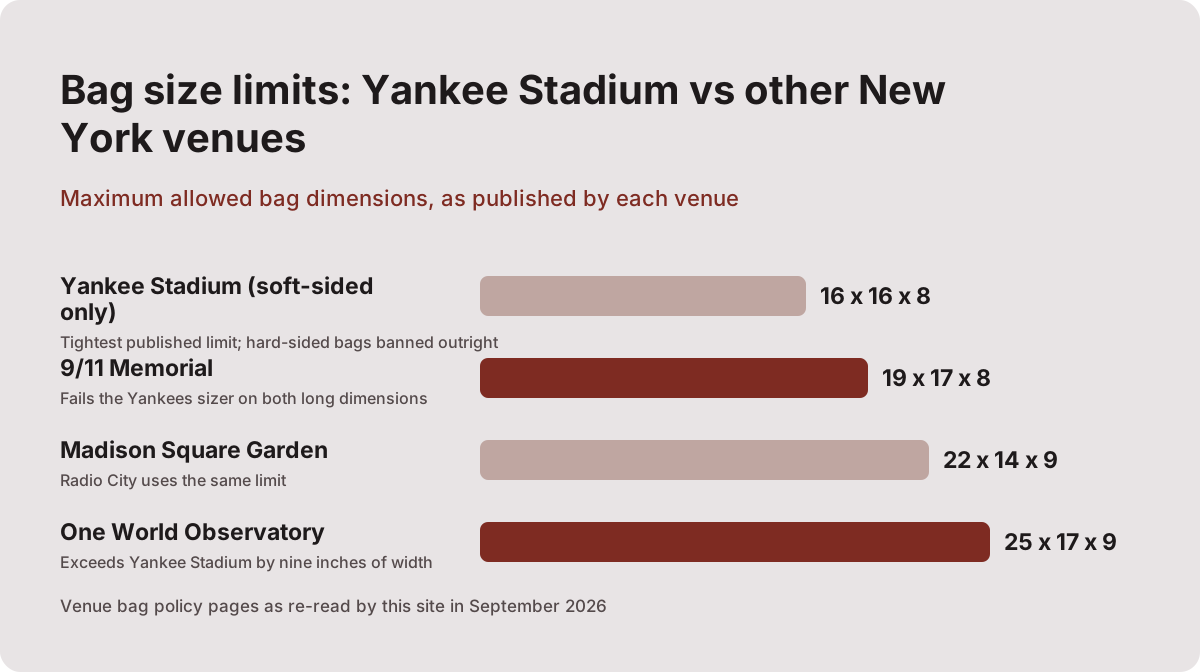
The Yankees' policy is worth reading carefully because it is stricter than most of the city. Madison Square Garden draws its line at 22 x 14 x 9 inches. One World Observatory allows up to 25 x 17 x 9. The 9/11 Memorial permits 19 x 17 x 8. Yankee Stadium's 16 x 16 x 8, soft-sided only, is the tightest published dimension of any high-volume venue this site has verified, and it is enforced with sizers at every entry inspection point.
What Exactly Does The Yankee Stadium Bag Policy Allow?
Each guest may bring one MLB-compliant bag, defined by Major League Baseball as soft-sided and no larger than 16 inches by 16 inches by 8 inches, plus one smaller soft-sided personal item such as a handbag, clutch, tote or plastic grocery bag. All hard-sided bags and containers are strictly prohibited, sizers are used at every entry point, and there is no storage area for any items at Yankee Stadium.
That is the whole of the published rule, and the Yankees state it on their own ballpark information page, which this site re-read in full in September 2026 and found unchanged. The wording matters in three places. First, "soft-sided" is not a suggestion: a hard-sided case that happens to measure under 16 x 16 x 8 is still prohibited, because the ban on hard-sided bags and containers is absolute and listed separately from the size test. Second, the policy covers New York Yankees games specifically, so a concert or another event at the Stadium may carry different rules, and the Yankees say so by scoping the rule to "New York Yankees games". Third, the sizer sentence is the operational heart of it: "Sizers will be used at entry inspection points to confirm the size of all bags and personal items, which must fit without assistance, modification or adjustment." A bag that only fits when squeezed, pushed or re-packed at the gate does not pass.
| Item | Allowed at Yankees games? | The published basis |
|---|---|---|
| One soft-sided bag up to 16 x 16 x 8 inches | Yes, one per guest | "one MLB-compliant bag" |
| One smaller soft-sided personal item | Yes | "handbag, clutch, tote or plastic grocery bag" |
| Any hard-sided bag or container | No, regardless of size | "strictly prohibited" |
| A bag that needs squeezing to fit the sizer | No | "without assistance, modification or adjustment" |
| Luggage, suitcases, wheeled cases | No | Exceeds the limit, and hard-sided cases banned outright |
| Leaving a bag somewhere inside the Stadium | No | "There is no storage area for any items at Yankee Stadium" |
The personal-item allowance is where most confusion happens. The policy's own examples, a handbag, a clutch, a tote, a plastic grocery bag, are all soft and small, so a backpack does not obviously qualify as the "one MLB-compliant bag" unless it is soft-sided and fits the dimensions. A fan bringing both a qualifying bag and a backpack is over the limit, because the rule allows one of each category, not one of everything. The Yankees' page is published at mlb.com/yankees/ballpark/information/policies, and it is the only source for any of this: no third-party summary should be trusted over the club's own text.
Can You Check A Bag Or Store Luggage Inside Yankee Stadium?
No. The Yankees publish the answer in a single sentence on their own policies page: "There is no storage area for any items at Yankee Stadium." There is no bag check, no locker bank, no cloakroom and no third-party storage concession inside the ballpark, and no partner is named anywhere in the published policy.
This is the sentence that separates Yankee Stadium from venues that at least offer a partial solution. The 9/11 Memorial and Museum runs Coat Rooms and requires oversized visitors' items to be stored in them for the duration of a visit. The American Museum of Natural History sells day lockers at $7 for a small size and $12 for a large, though even there luggage is refused at the door. MoMA and the Guggenheim both operate checkrooms. Yankee Stadium offers none of this. The policy is not silent on the question, which would leave room to hope; it states the absence directly, which closes it.
The practical consequence is that the decision has to be made before travel, not at the gate. A fan who takes the subway or the LIRR to the Bronx with a suitcase has no fallback: the bag fails the sizer, the Stadium has no place to hold it, and the choice becomes missing the game or abandoning the bag, which no one should do. The unattended-item rules on the transit side make that worse rather than better. The LIRR's own published luggage rule, in its City Terminal timetable effective March 23, 2026, states that "Luggage may not be left unattended" and that "Bags and containers are subject to random search by MTA police." A suitcase parked on a Bronx platform is inside that rule the moment its owner walks away.
That is why the storage question is a Yankees-game question as much as a sightseeing one. The staffed bag-drop points this site lists across Manhattan and Brooklyn are all indoor counters at shops, cafes and hotels, none of them lockers, and they take suitcases the Stadium will not. Times Square carries 44 storage points within 800 metres of its anchor, rated 4.79 across 2400 reviews. Midtown Manhattan has 16 points rated 4.7 across 596 reviews, and Brooklyn has 11 points rated 4.82 across 79 reviews. Typical pricing is $4.90 per bag per day plus a $1.99 per-bag checkout fee, so a single bag for a game-day drop costs $6.89 all in.
Where Should You Leave Luggage Before Heading To A Yankees Game?
Leave the bag at a staffed storage point near your hotel or your route through Manhattan, not near the Stadium. The Bronx has no published bag-storage inventory on this site's roster, the subway has no suitcase-size rule but does fine obstruction, and a midtown or Times Square drop keeps the case off the trains entirely. Typical cost is $4.90 per bag per day plus the $1.99 checkout fee.
The geography is the honest constraint. This site's eight storage areas, 88 distinct points in total, cluster in Manhattan and Brooklyn. Nothing in the roster sits within walking distance of the ballpark in the Bronx, and inventing a Bronx option that does not exist would help nobody. The realistic patterns are two. A guest staying in Midtown drops the bag on the way to the 4, B or D train, or on the way to Grand Central for the LIRR's direct service to the Stadium station. A guest in Brooklyn drops the case before crossing the river. In both cases the bag travels zero stops.
Midtown Manhattan's 16 points are the natural fit for anyone whose route to the Bronx runs through Penn Station, Grand Central or Times Square, and the area's 14 points that publish a rating average 4.7 across 596 reviews, with 15 of the 16 publishing opening hours. The area page for Midtown Manhattan bag drop options lists every point with its hours, so a fan can pick one that opens early enough for a day game. The $4.90 day rate plus the $1.99 per-bag checkout fee is the same across the roster, and the fee is charged once per bag rather than per night, so a bag left from morning until after the last out is still a one-day charge.
Times Square is the volume option: 44 points within 800 metres, 42 of them publishing hours, rated 4.79 across 2400 reviews. It suits a fan who is combining the game with anything in the theatre district, and the sheer count means the odds of a same-morning booking are good. Brooklyn's 11 points, rated 4.82 across 79 reviews, are the smaller pool, and the honest note is that 79 reviews is a modest base compared with Manhattan's thousands, so the rating carries less weight rather than more.
There is a planning question worth settling before booking any of them: what a New York bag drop actually does with a case, and how the handover works. This site's separate guide on how a New York bag drop-off works walks through the whole exchange, from booking an area rather than a street address to what the terms say about electronics, which are a prohibited storage category under the operator's own published terms.
How Strict Is The Yankees' Rule Compared With Other New York Venues?
Yankee Stadium's 16 x 16 x 8 soft-sided limit is the tightest published bag dimension of any major New York venue this site has verified. Madison Square Garden and Radio City draw the line at 22 x 14 x 9, the 9/11 Memorial at 19 x 17 x 8, One World Observatory at 25 x 17 x 9, and the American Museum of Natural History refuses anything over 11 x 17 inches outright.
The comparison matters because travellers routinely assume one venue's number applies citywide, and the numbers differ enormously. A bag that sails into One World Observatory fails at Yankee Stadium by nine inches of width. A bag that fits the 9/11 Memorial's 19 x 17 x 8 fails the Yankees' sizer on both long dimensions. And the storage half of the comparison differs just as much: several venues that refuse luggage at least hold smaller bags somewhere, while the Stadium, MSG and Radio City all publish that they provide no bag check at all.
| Venue | Published size limit | Bag or coat check on site | Luggage admitted? |
|---|---|---|---|
| Yankee Stadium | 16 x 16 x 8 in, soft-sided only | No, "no storage area for any items" | No |
| Madison Square Garden | 22 x 14 x 9 in | No | No, oversized bags prohibited |
| Radio City Music Hall | 22 x 14 x 9 in | No | No, oversized bags prohibited |
| One World Observatory | 25 x 17 x 9 in | No, "no lockers or storage capabilities" | No |
| 9/11 Memorial & Museum | 19 x 17 x 8 in onto the Memorial | Yes, Coat Rooms | Large items stored or refused |
| American Museum of Natural History | Over 11 x 17 in refused | Yes, paid lockers $7 / $12 per day | No, refused at the door |
| Whitney Museum | Not published as a dimension | Yes, complimentary coat check | No, "any size or type" prohibited |
| Nederlander Broadway theatres | 20 x 14 x 9 in | Not published | No, "Luggage is prohibited" |
Two rows deserve their own words. The 9/11 Memorial and Museum is the only venue on the list that both refuses large bags and requires visitors to store them in its own Coat Rooms, located on the Concourse Lobby level and the Pavilion Auditorium level, with the published caveat that security "may not admit, nor provide storage for, visitors' large personal items". The Broadway row comes from the Nederlander Organization's own theatre pages, which publish an identical block across its houses: bags larger than 20 x 14 x 9 "cannot be checked or allowed inside the theatre" and "Luggage is prohibited". That is a Nederlander rule verified on three of its theatres, not a Broadway-wide policy; Shubert publishes no bag rule at all. This site's guide to Broadway theatre bag rules keeps the two owners' positions separate.
What Are The Rules For Getting A Bag To The Stadium On The Subway Or LIRR?
The MTA publishes no suitcase size limit for the subway at all: the only dimension in its Rules of Conduct, 30 inches, applies to wheeled carts, not luggage. What the rules do carry are fines, $75 for obstructive objects, $50 for obstruction of seating and facilities, $100 for obstruction of operations, and the LIRR's timetable states that luggage may not be left unattended.
The August 2025 edition of the MTA Rules of Conduct, 21 NYCRR Part 1050, was opened directly for this site's record, and the finding is genuinely useful for anyone planning a trip with a case: there is no measurement a suitcase has to pass. Section 1050.9(g) bans "any wheeled cart greater than thirty inches in either length or width" and any item that extends outside a car window or door, constitutes a hazard, or impedes service. A suitcase is judged on behaviour, not inches. Put the case on the seat beside you and section 1050.7(j) applies, the rule against occupying more than one seat when it interferes with other passengers, and the fine schedule prices that at $50. Block a door or a passage and the obstruction fines run $75 to $100.
| Rule | What the published text says | Fine in the MTA schedule |
|---|---|---|
| 1050.9(g) carts and long objects | No wheeled cart greater than thirty inches in length or width; nothing so long it extends outside a car window or door | $75 |
| 1050.9(g) obstructive objects | Anything that interferes with passenger traffic or impedes service | $75 |
| 1050.7(j) obstruction of seating | Occupying more than one seat, or blocking facilities, elevators or escalators | $50 |
| 1050.6(a) obstruction of operations | Obstruction of operations or traffic | $100 |
The MTA's own rider guide adds advice aimed squarely at this situation, in the agency's words: "Don't travel with more than you can carry on your own, and avoid rush hour if you're transporting something big. Make space for other riders and don't block doors, stairs, or passageways." A Yankees game adds its own rush, and it is a concentrated one: thousands of fans board the 4, B and D trains and the LIRR's game-day service within the same short window before first pitch. The rider guide is published at mta.info/guides/riding-the-subway, and its advice is the transit version of the Stadium's own no-storage line: solve the bag problem earlier in the day.
One honest negative belongs here too, because plenty of content asserts the opposite. The MTA Rules of Conduct contain no unattended-property provision at all: a full-text search returns zero matches for "unattended" and zero for "abandon". The subway rulebook does not ban leaving a bag, and this site will not write that it does. Other New York operators do publish exactly that rule, including the Port Authority Bus Terminal, whose regulations state "No person shall abandon any property at the Terminal", and the Staten Island Ferry, whose passenger rules forbid leaving property unattended in terminals or on ferries. The LIRR's timetable line, "Luggage may not be left unattended", sits in the same family. The detail is on this site's guide to taking luggage on the subway and commuter rail.
What About Medical Bags, Cameras And Other Exceptions?
The Yankees' published policy names no exceptions: it allows one MLB-compliant bag and one smaller soft-sided personal item, and the page this site re-read carries no medical-bag clause, no camera clause and no dimensional carve-out of any kind. Fans with medical needs or camera equipment should contact the Stadium directly before travelling, because the published text gives them nothing to rely on at the gate.
That is a deliberately narrow statement, and it is the honest one. Many venues publish an explicit medical-bag exception; the Yankees' page, as re-read in full, does not. The page's only concession to individual circumstances is the sentence that follows the bag rule in the general policies: guests with additional needs are directed to contact Guest Relations. A fan who needs to carry insulin, an EpiPen kit or other medical equipment larger than the personal-item allowance has no published protection, and arriving to argue the point at a sizer is a bad plan. Calling ahead is the only sourced advice that can be given.
Cameras fall into a similar gap. The published policy governs bags, not the equipment inside them, and a camera that fits the 16 x 16 x 8 soft-sided limit travels with the bag it is in. A camera bag with a hard shell is prohibited regardless of size, because the hard-sided ban is separate. The Statue of Liberty offers a useful contrast in how specific a venue can be when it wants to: the National Park Service publishes that Crown ticket holders may carry only a camera without a camera bag, a phone, water in a clear container and necessary medication, with "All other items must be stored in lockers". The Yankees publish nothing remotely that granular, so the safe reading is the literal one: one compliant bag, one personal item, nothing else guaranteed.
How Should A Visitor Plan The Whole Bag On Game Day?
Drop the suitcase at a staffed storage point in the neighbourhood you are leaving from, carry only what fits the 16 x 16 x 8 soft-sided rule to the Bronx, and plan the retrieval for after the game with the point's published hours in mind. A one-day, one-bag drop costs $6.89 all in at the typical $4.90 day rate plus the $1.99 checkout fee, and every point on this roster is a staffed counter.
The retrieval half of the plan is the one people forget. A night game ends late, and a storage point that closes at six or seven in the evening is useless for a same-day pickup. This is why the roster records how many points publish hours in each area: 42 of 44 in Times Square, 15 of 16 in Midtown Manhattan, all 11 in Brooklyn. Booking a point that is open past the final out, or planning an overnight hold and collecting the case the next morning, are the two patterns that actually work. The overnight option is real: the day rate is per bag per day, and the checkout fee is charged once per bag rather than per night, so a longer hold adds only the daily rate after the first day.
For a fan whose whole day is built around the game, the sequence is simple. Book the drop near the hotel or the transit hub in the morning, travel to the Stadium with the compliant bag only, watch the game, and collect the case either the same night from a late-opening point or the next morning. The one thing not to do is carry the suitcase to the gate and hope. The sizer will do its job, the Stadium has published that it has no storage area for any items, and there is no second chance inside the building. The full planning detail, including what the operator's terms cover and what they exclude, is in this site's guide to how to choose a luggage storage spot in New York, and the question of what cannot be left in a stored bag, electronics above all, is covered in what you cannot leave in a stored bag in New York.
Brooklyn deserves its own word for the fan staying across the river. Its 11 points are fewer than Manhattan's dozens, but all of them publish hours and the area rates 4.82 across 79 reviews, and a Brooklyn drop before a Manhattan-bound train removes the case from the whole journey. Times Square remains the fallback with the deepest inventory, and the two areas together cover most realistic game-day routes.
For the traveller who wants the whole picture in one place, this site's Luggage Storage Lockers in New York City homepage collects all eight areas and the honest headline finding behind them: New York's transport hubs have almost no public lockers, and every one of the 88 points on this roster is a staffed counter. The Yankees' ballpark is the purest example of why that matters. The rule is strict, the storage is absent, and the solution is a booking made before the day starts.
Common Questions About The Yankee Stadium Bag Policy
What is the Yankee Stadium bag policy?
For New York Yankees games, each guest may bring one MLB-compliant bag, defined by Major League Baseball as soft-sided and no larger than 16 inches by 16 inches by 8 inches, plus one smaller soft-sided personal item such as a handbag, clutch, tote or plastic grocery bag. All hard-sided bags and containers are strictly prohibited, sizers are used at entry inspection points, and the Yankees publish that there is no storage area for any items at Yankee Stadium.
Can I bring a backpack to Yankee Stadium?
Only as the one MLB-compliant bag, and only if it is soft-sided and fits within 16 x 16 x 8 inches without assistance, modification or adjustment. A hard-sided backpack is prohibited regardless of size. Bringing both a compliant bag and a backpack exceeds the published allowance of one bag plus one smaller personal item.
Does Yankee Stadium have lockers or a bag check?
No. The Yankees' own policies page states: "There is no storage area for any items at Yankee Stadium." There is no bag check, no locker bank, no cloakroom and no named storage partner, so a bag that fails the sizer at the gate has nowhere inside the ballpark to go.
Where can I leave luggage before a Yankees game?
At a staffed bag-drop point along your route, most realistically in Manhattan or Brooklyn. Times Square has 44 points within 800 metres of its anchor, Midtown Manhattan has 16 and Brooklyn has 11, all staffed counters rather than lockers. Typical pricing is $4.90 per bag per day plus a $1.99 per-bag checkout fee, and points that publish late hours allow a same-night pickup after the game.
Can I bring a suitcase on the subway to the Stadium?
Yes, because the MTA publishes no suitcase size limit; its only carry dimension, thirty inches, applies to wheeled carts. But the rules fine obstruction of seating at $50 and obstruction of operations at up to $100, and the LIRR timetable states luggage may not be left unattended. The MTA's own rider guide advises not travelling with more than you can carry and avoiding rush hour with something big.
Is the Yankees' bag rule stricter than other New York venues?
Yes. Yankee Stadium's 16 x 16 x 8 soft-sided limit is the tightest published dimension of any major New York venue this site has verified. Madison Square Garden and Radio City allow 22 x 14 x 9, the 9/11 Memorial 19 x 17 x 8, One World Observatory 25 x 17 x 9, and the American Museum of Natural History refuses anything over 11 x 17 inches, though it at least sells day lockers for smaller bags.